
Aangan by Khadija Mastoor – Complete PDF Download
urdunovelspdf.com
| Novel Details | Information |
|---|---|
| Novel Name | Aangan (آنگن, also spelled Angan) – The Courtyard |
| Author Name | Khadija Mastoor |
| Novel Genre | Historical Fiction, Social Novel, Partition Literature |
| Language | Urdu (English translations available) |
| First Published | 1962 (first edition 488 pages) |
| Award | Adamjee Literary Award for Urdu prose, 1963 |
| Novel Status | Complete |
What Is Aangan About?
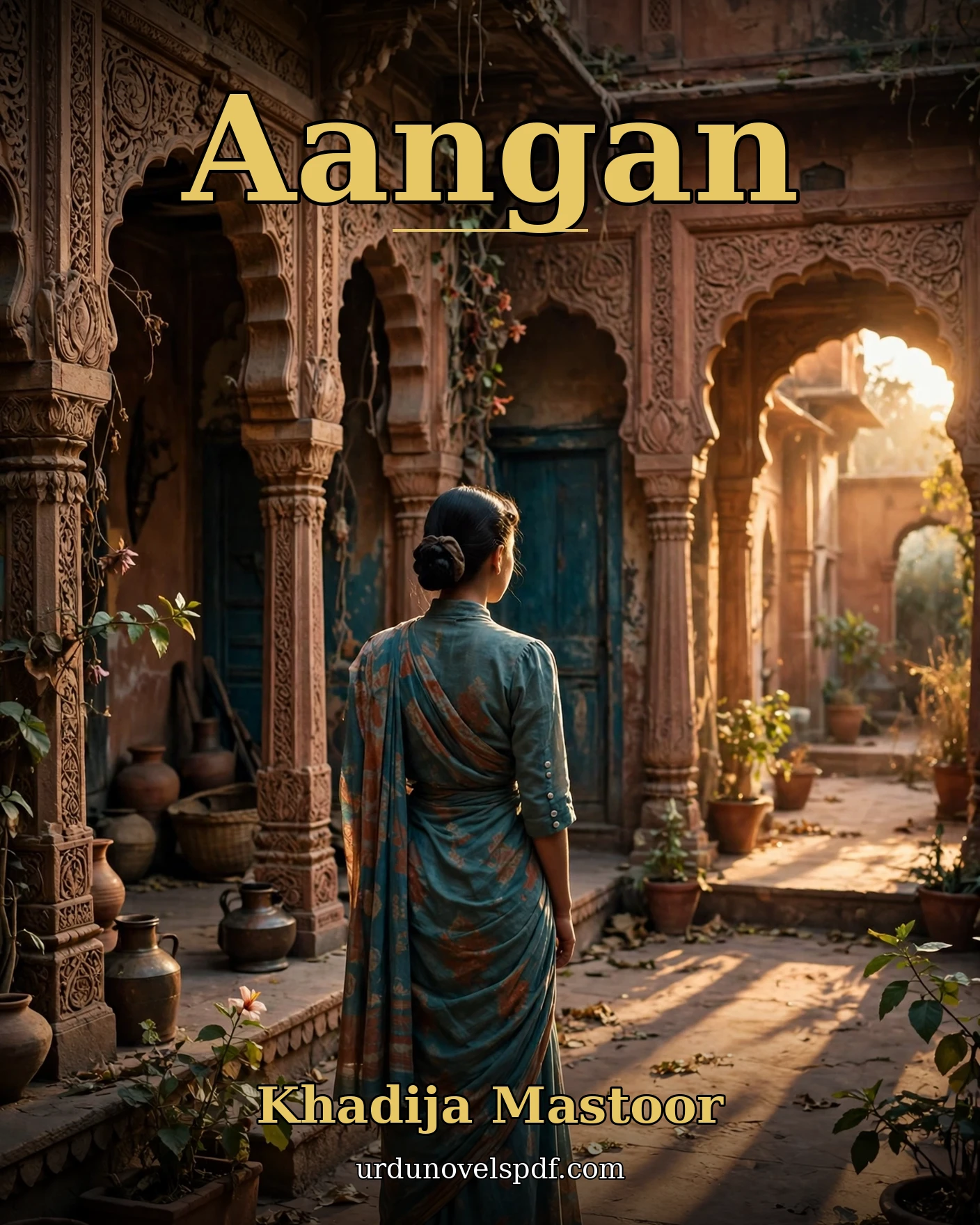
Aangan follows an extended Muslim family in the years before Partition, and most of the novel unfolds in and around the courtyard of a single large house. The freedom movement is not background decoration here. It sits at the family table. Different members support different political causes, and those loyalties slowly turn into personal rifts. One of the sharpest divides is between Jameel, who supports the Muslim League, and his own father, a staunch supporter of Congress. Father and son stop speaking, and the whole household feels the strain.
We see much of this through Aaliya, the novel’s central voice. Her father’s involvement in politics disrupts her home life, and she and her mother move into her uncle’s house. From there, Aaliya observes the older generation, her sister, her cousins and the servants of the house, and she begins to form her own ideas about love, duty and independence. The novel takes in major events of the period, including the freedom struggle, the Second World War and the creation of Pakistan, but it never loses sight of the private cost. Houses are divided, marriages are arranged or blocked, and young women pay the highest price for decisions they did not make.
What makes Aangan unusual among Partition novels is its restraint. The violence of history mostly arrives second hand, as news, as an arrest, as a letter, as a family member who does not come home. Mastoor keeps her camera inside the courtyard, and that is the point. Political slogans sound grand outside. Inside the courtyard, they mean broken relationships, lost income and families splitting apart. The novel’s closing movement carries Aaliya into the new Pakistan, where she works with poor children and in a refugee camp, and refuses to surrender her independence for an expected marriage.
Is Aangan a Romantic Novel?
Honestly, no, not in the sense most download pages use the word. There are love stories in Aangan, and some of them are deeply felt, but none of them is the point of the book. The point is what happens to women when love, family pride, politics and money all pull in different directions, and how one young woman decides she will not let any of them decide her life for her.
Main Characters in Aangan
Aaliya is the central voice: observant, questioning and quietly stubborn. She continues her education, works towards financial independence and, after Partition, teaches poor children in the new Pakistan. Tehmina, her elder sister, is more romantic and more willing to believe that love will rescue her from a restricted life; her painful story shapes Aaliya deeply. Jameel, Aaliya’s cousin, is a poet and a politically committed young man whose Muslim League support clashes with his Congress-supporting father. Chammi, spirited and outspoken, brings energy and mischief into the courtyard. Safdar belongs to the younger generation, his romantic hopes caught up in the disapproval and pride of the elders. Around them stand Kusum, a neighbour and friend of the sisters, and Kariman Bua, the long-serving housekeeper.
Themes: Why Aangan Is Called a Feminist Classic
The most discussed theme of Aangan is the position of women. Mastoor shows a society that trains girls from childhood for marriage and obedience, and then blames them when those narrow lives go wrong. Aaliya’s insistence on education and earning her own living is a direct answer to that training, which is why the novel is often described as a feminist classic. Partition and the freedom movement form the second major theme, but Mastoor treats them from inside the home. Family pride and class run through the book as well: elders protect the family’s name while quietly damaging the people inside it, and love is judged against status, money and reputation, and usually loses.
Aangan Novel vs the Hum TV Drama (2018)
The Hum TV serial Aangan was broadcast from 20 December 2018 to 27 June 2019, produced by Momina Duraid under MD Productions, directed by Mohammed Ehteshamuddin and written for television by Mustafa Afridi. Mawra Hocane played Aaliya, Ahad Raza Mir played Jameel, Sajal Aly played Chammi, Ahsan Khan played both Subhan and Safdar, Sonya Hussyn played Salma, Hira Mani played Tehmina and Rabia Butt played Kusum. The serial received multiple nominations at the 19th Lux Style Awards. The drama expands some threads and gives certain characters, including Salma and Subhan, more screen space than a first reading of the novel might suggest, but the broad shape stays faithful: one family, one courtyard and a country dividing around them. Note that Aangan Terha, Anwar Maqsood’s 1980s satirical television play, is a completely different work.
Which Edition or Translation Should You Read?
If you read Urdu, look for the Sang-e-Meel Publications Urdu edition. If you read English, you have two respected translations: Neelam Hussain’s “The Inner Courtyard” (2001) and Daisy Rockwell’s “The Women’s Courtyard” (2018, Penguin Classics). Page counts differ by edition (first edition 488 pages, modern Urdu around 318, Penguin English 320), but these are the same novel in different settings, not different books. Searching under “Khadija Mastur” in translated editions will also help you find a copy.
About the Author: Khadija Mastoor
Khadija Mastoor (1927-1982) was a Pakistani Urdu-language short story writer and novelist, born in Bareilly on 11 December 1927. She migrated to Lahore with her family after the independence of Pakistan in 1947 and settled there. She began writing short stories in 1942, and went on to publish five short-story collections and two novels: Aangan (1962) and Zameen (1983). Her younger sister Hajra Masroor was also a writer. Aangan remains her defining work. A short content note for sensitive readers: the novel deals with loss, displacement, family conflict and painful love stories set against Partition.
PDF Download
Read Aangan online or download the complete PDF free using the buttons below. Both buttons use the owner-supplied download link, which will be added at publish time.
Frequently Asked Questions
Who is the author of Aangan?
What does Aangan mean?
Is Aangan a complete novel?
Is Aangan a romantic novel?
Does Aangan have a happy ending?
Is Aangan the same as Aangan Terha?
Is it spelled Aangan or Angan?
Is Aangan available in English?
📚 More Urdu Novels You Will Love
Explore more classic Urdu novels:
Final Verdict
Aangan by Khadija Mastoor is a classic of Urdu literature about one courtyard, one family and a country dividing around them. Mastoor shows that history is not only made in assemblies and on battlefields. It is made, and paid for, in kitchens and courtyards, by women who were never asked.
Use the buttons above to read Aangan online or download the complete PDF free. Start reading today.

6 Comments