
Zarguzasht by Mushtaq Ahmad Yousufi – Complete PDF Download
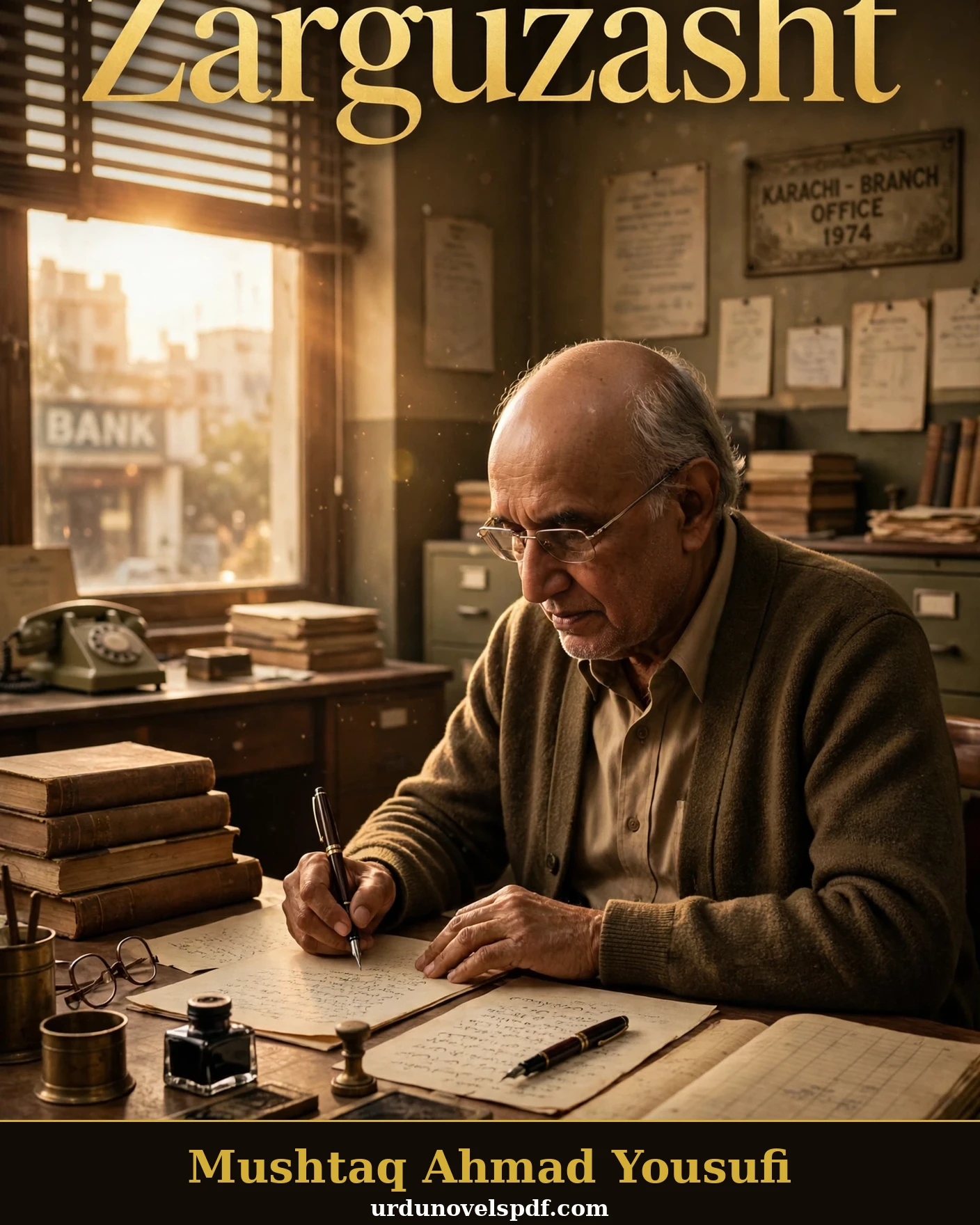
urdunovelspdf.com
| Book Details | Information |
|---|---|
| Book Name | Zarguzasht (زرگزشت) |
| Author Name | Mushtaq Ahmad Yousufi |
| Book Genre | Satire, Humour, Autobiographical Essays and Sketches |
| First Published | 1976 |
| Language | Urdu |
| Book Status | Complete |
| Availability | Read Online and Complete PDF Download |
What Is Known About This Book
The firm facts are these. Zarguzasht first appeared in 1976, between Yousufi’s Khakam Badahan (1969) and Aab-e-Gum (1990). Dawn’s obituary coverage called it “a nostalgic account peppered with witty one-liners and anecdotes” and “often hailed as Yousufi’s best work”. A research paper in GCUF’s Zaban-o-Adab journal treats it as Yousufi’s autobiography, analysing how he turns his banking colleagues, their habits, qualities and natural attitudes, into his subject matter, weighing their strengths and follies together. Nothing further about the book’s contents is claimed here beyond what published profiles and criticism report, and no episode, character or storyline has been invented for this page.
Within those limits, the shape of the book is clear. It is episodic: sketches and essays, each complete in itself, returning to the same world from a new angle. A reader can open it anywhere and read one piece with full satisfaction. That is the honest answer to the search query “Zarguzasht story”: there is no single story, and a page that invents one is not summarising the book.
Zarguzasht Meaning and the Mr Anderson Opening
The title is a joke, and the joke is the introduction. Sarguzasht means autobiography in Urdu. Yousufi changes one letter to make Zarguzasht, rendered as “Lost Treasure”: a life story that announces, in its own name, that it will not be solemn. The treasure is memory, and the comedy inside it.
One opening scene is reported consistently enough to mention, and it sets the book’s tone. Zarguzasht begins with the author’s interview for his first banking job, where he meets his boss, Mr Anderson. Anderson’s opening questions are blunt to the point of comedy: “How are you? Who are you? What are you? And why are you?” Asked about his family, the young Yousufi answers, “From my own family”, and Anderson thanks him for his honesty. Keep that exchange in mind and you understand the book’s method: a real encounter, kept exactly, allowed to be funny on its own.
The Author: Mushtaq Ahmad Yousufi
Mushtaq Ahmad Yousufi was born on 4 September 1923 in Tonk, Rajasthan, in British India, into a well-educated family. His father was Speaker of the Jaipur Legislative Assembly. He studied at Agra University and Aligarh Muslim University, taking an M.A. in Philosophy and an LL.B. After Partition his family migrated to Pakistan. He joined Muslim Commercial Bank in 1950, worked for Allied Bank and United Bank, and became chairman of the Pakistan Banking Council in 1977, running a distinguished banking career alongside his writing for decades.
His books in order are Chiragh Talay (1961), Khakam Badahan (1969), Zarguzasht (1976), Aab-e-Gum (1990) and Sham-e-Shair-e-Yaaran (2014). He received the Sitara-e-Imtiaz in 1999, the Hilal-e-Imtiaz in 2002, and the Kamal-e-Fun Award in 1999. Ibn-e-Insha said that if Urdu literary humour of the time could be given a single name, it would be Yusufi’s. Obituaries after his death in Karachi on 20 June 2018 called him the Mark Twain of Urdu literature, and Intizar Husain famously remarked that Yusufi’s work is “untranslatable”.
That last remark explains a common confusion. The Yousufi book translated into English as Mirages of the Mind is the later Aab-e-Gum, with Basharat and his family and the Partition journey from Kanpur to Karachi. Those characters belong to Aab-e-Gum, not to Zarguzasht, and this page keeps the two books separate.
Why Zarguzasht Still Matters, and How to Read It
Zarguzasht matters for three reasons. First, its material is lived experience, so its comedy has an authority invented humour cannot fake. Second, it satirises follies and systems rather than humiliating individuals, which is why it still reads as affectionate rather than cruel. Third, the prose is the performance: wordplay, Persian and Urdu verse, quotations from Shakespeare, Donne, Proust, Kipling and Mark Twain, and sudden philosophical asides, all revised by a famously meticulous author until they sounded effortless. Yousufi called humour a “wall of laughter” between man and the bitter facts of life, and this book is that wall at its strongest.
Read it as essays, not as a novel. Read one sketch at a time. Confident Urdu readers can start with Zarguzasht itself, since each piece stands alone. Newer readers may start with the shorter Chiragh Talay (1961) or read Zarguzasht slowly with a dictionary nearby. The classical vocabulary is genuinely demanding, and pausing over a word is normal even for experienced readers. Notice the small details as you go: a repeated phrase, a formality hiding a vanity, a quotation that quietly changes the paragraph before it. That is where the book lives.
Frequently Asked Questions
Is Zarguzasht a novel?
Who wrote Zarguzasht?
When was Zarguzasht published?
What is Zarguzasht about?
What does Zarguzasht mean?
Is Zarguzasht complete?
Is there an English translation of Zarguzasht?
Which Yousufi book should I read first?
📗 More Classic Urdu Books You Will Love
Explore more complete classic books free on Urdunovelspdf.com:
Final Verdict
Zarguzasht by Mushtaq Ahmad Yousufi is the book to read if you want to know why Yousufi is called the Mark Twain of Urdu literature. It asks for no plot summary, because it offers something better: a working life remembered with wit, offices and colleagues turned into sketches that are funny at first reading and truer at the second.
The complete book is available for free. Click Read Online or Download PDF above to start reading today.
3 Comments