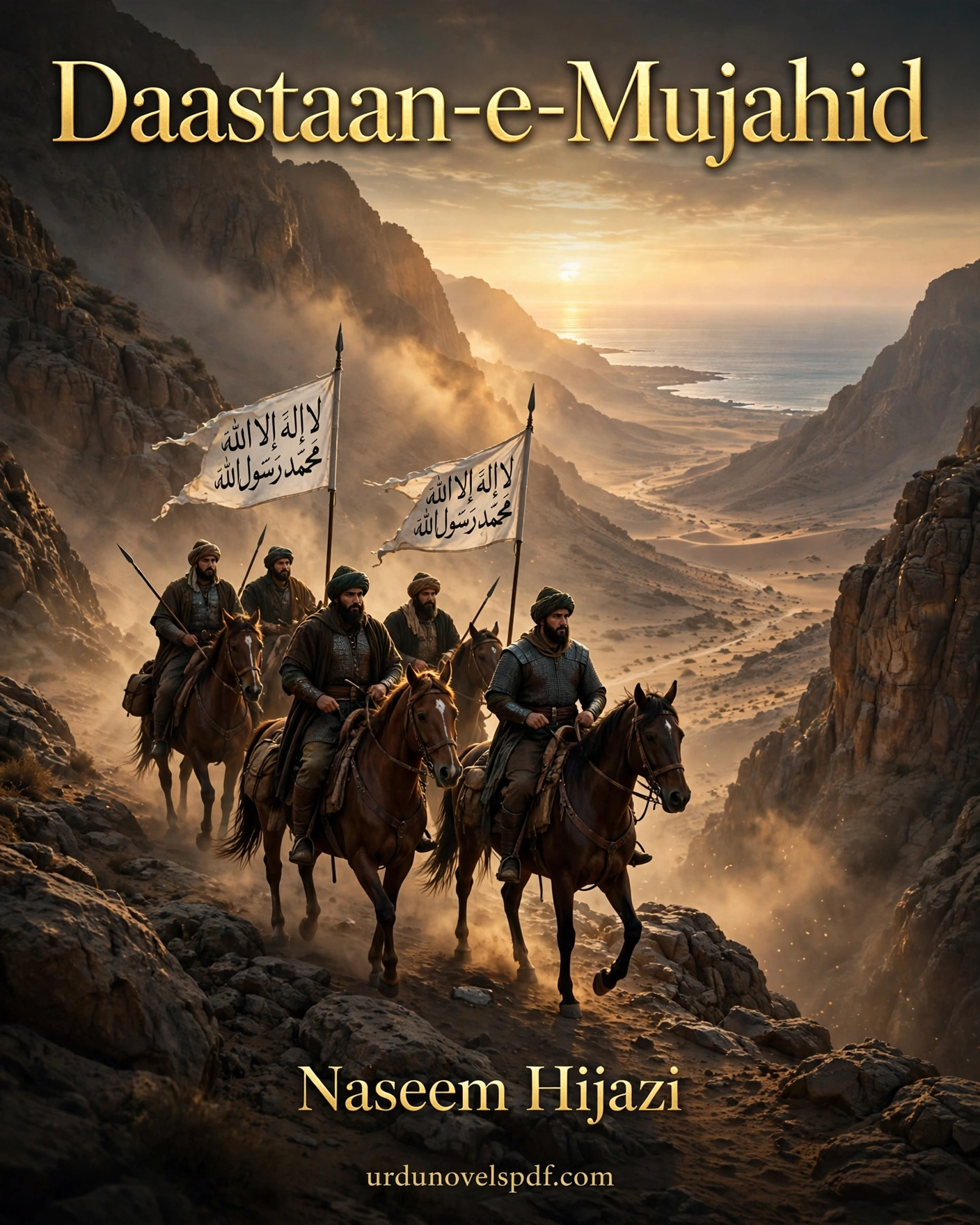
Daastaan-e-Mujahid by Naseem Hijazi – Complete PDF Download
urdunovelspdf.com
Daastaan-e-Mujahid by Naseem Hijazi is one of the most important historical novels in Urdu, and this page gives you the complete novel to read online and download as a PDF, together with an honest guide to what it actually is, what period it covers, and why it still matters today.
Before you download anything, one fact matters more than any other.
This is not a love story.
There is no romantic hero waiting in the next chapter, no heroine, no love triangle, and no plot twist about a relationship to spoil.
Daastaan-e-Mujahid is a historical novel about soldiers, faith, discipline and conquest in the early centuries of Islam, and it speaks to a whole community and its history rather than to the fate of one fictional couple.
This page therefore tells it plainly, right at the start, so that no reader opens the book expecting a romance and finds a battlefield instead.
The title itself tells you the subject.
Daastaan means a tale or story, and mujahid means one who strives, a soldier of faith.
In English the title is often rendered as A Soldier’s Tale.
The novel covers the glorious and testing period of the early Muslim conquests, when Muslim armies moved on several fronts at once.
Spain, Sindh, Central Asia and North Africa all appear in its sweep, and the names that every source connects with this book are three great commanders of that age.
Those commanders are Tariq bin Ziyad, Muhammad bin Qasim and Qutayba bin Muslim.
If you have come here because you love Islamic history, or because you want to know where Naseem Hijazi began as a novelist, then you have found exactly the right book.
Quick Answer: Daastaan-e-Mujahid by Naseem Hijazi is a complete historical Urdu novel, the author’s first novel, written in the late 1930s and first published in the early 1940s. It tells the story of the early Muslim conquests in Spain, Sindh, Central Asia and North Africa during the Umayyad period, through the campaigns associated with Tariq bin Ziyad, Muhammad bin Qasim and Qutayba bin Muslim. It is a novel about soldiers, faith and sacrifice, not a romance. Read it online or download the complete PDF using the buttons on this page.
Key Facts
- Book: Daastaan-e-Mujahid, Urdu title داستان مجاہد, English rendering A Soldier’s Tale.
- Author: Naseem Hijazi, the pen name of Sharif Hussain (1914 to 1996).
- Genre: historical novel, not a romance novel and not a love story.
- Place in the author’s work: Hijazi’s first novel, the book that launched his career as a historical novelist.
- Historical setting: the Arab Umayyad Caliphate, the period of Walid bin Abdul Malik, the age of the early conquests.
- Fronts covered: Al-Andalus (Spain), Sindh, Central Asia and the Maghreb (North Africa).
- Commanders named in the sources: Tariq bin Ziyad, Muhammad bin Qasim and Qutayba bin Muslim.
- Language: Urdu, in Hijazi’s direct and stirring narrative style.
- Availability: complete PDF download and read online on this page.
| Novel Details | Information |
|---|---|
| Novel Name | Daastaan-e-Mujahid |
| Author Name | Naseem Hijazi (Sharif Hussain) |
| Novel Genre | Historical, Islamic history, war and conquest |
| Historical Period | Umayyad Caliphate, age of the early Muslim conquests |
| Main Fronts | Spain (Al-Andalus), Sindh, Central Asia, North Africa (Maghreb) |
| Famous Commanders | Tariq bin Ziyad, Muhammad bin Qasim, Qutayba bin Muslim |
| First Novel | Yes, Naseem Hijazi’s first novel |
| First Published | Early 1940s (sources differ: 1943 or 1944, see the note below) |
| Novel Status | ✅ Complete |
| Language | Urdu |
| Availability | Free PDF Download and Read Online |
What Kind of Book Is Daastaan-e-Mujahid?
Daastaan-e-Mujahid is a historical novel.
That single sentence is the most important thing on this page, because several websites file the book under romance-style labels that do not fit it at all.
One popular novels site, for example, lists it as an army-based Islamic novel and then reviews it in the language of love stories, talking about love, relationships, restraint and responsibility as if it were a romantic drama.
That framing is wrong, and it misleads the reader.
A reader who downloads the book expecting a love story will be confused within the first pages, and a reader who wants Islamic history may skip the book entirely because the label makes it sound like something else.
So let us be exact: this book belongs with historical novels, with books about the rise and fall of Muslim rule, and with war stories about faith and sacrifice.
It does not belong with romantic novels, and this page does not pretend otherwise.
A historical novel is not a history textbook, and it is not a romance either.
It takes real history as its background, real periods and real commanders as its anchors, and then tells a story inside that history so that the reader feels the age rather than merely memorising its dates.
Hijazi was a master of exactly this form.
His novels are famous for making the reader feel present in the scene, as if the marches, the camps and the battles were happening in front of him.
Daastaan-e-Mujahid Story Overview
The novel tells the story of the early Muslim conquests as a single great movement seen from several directions at once.
Instead of staying in one city or following one family, it moves across the map of the expanding Muslim world.
In the west, Muslim armies cross into Spain, the land the sources call Al-Andalus and Hispania.
In the east, they move into Sindh in the subcontinent.
In Central Asia, they press on towards Turkistan and beyond.
In North Africa, the Maghreb, they consolidate lands that would become the springboard for the crossing into Spain.
The effect is a panorama rather than a portrait: the reader sees an age, not just a person.
At the centre of that panorama stands the mujahid himself.
The novel presents the soldier not as a professional fighter chasing loot or glory, but as a man defined by faith, discipline and devotion to a cause.
He knows what love and devotion mean, but his devotion is to God and to his community, not to a romantic beloved.
He endures hardship, long marches, strange lands and the fear of battle, and he does so because he believes his struggle has meaning beyond himself.
The emotions are real, but they are the emotions of war, faith and brotherhood, not the emotions of romance.
Readers who enjoy novels that show a community in a time of testing will recognise the same quality here that runs through other great Urdu historical fiction.
The theme of a community facing its own rise and its own dangers also runs through Aangan by Khadija Mastoor, although Aangan tells its story through a household in the years around Partition, while Daastaan-e-Mujahid tells its story through soldiers on distant frontiers.
The Historical Setting: The Umayyad Age of Conquests
To understand this novel, you need one paragraph of history, and this is it.
After the first generations of Islam, the Muslim state grew rapidly under the Umayyad Caliphate, which ruled from Damascus.
The period associated with this novel is the reign of Walid bin Abdul Malik, when the caliphate reached the height of its expansion.
Armies moved in several directions at the same time, and the sources for this book name four fronts again and again: Spain in the west, Sindh in the east, Central Asia in the north-east, and the Maghreb in North Africa.
The Three Commanders: Tariq bin Ziyad, Muhammad bin Qasim and Qutayba bin Muslim
Every source about this book names the same three commanders, and it is worth knowing who each one was, because they are real historical figures, not invented characters.
Tariq bin Ziyad is the commander associated with the crossing into Spain, the western conquest that opened Al-Andalus to Muslim rule.
His name is remembered wherever the story of Muslim Spain is told, and in this novel he stands for the western frontier: courage, crossing into the unknown, and the beginning of a civilisation that would last for centuries in Spain.
Muhammad bin Qasim is the commander associated with Sindh, the eastern conquest in the subcontinent.
He stands for the eastern frontier: youth, discipline and the meeting of Islam with the peoples of Sindh.
Qutayba bin Muslim is the commander associated with Central Asia, the north-eastern frontier, where Muslim armies pressed on into Turkistan and beyond.
He stands for the furthest reach of the conquests, the sense that the movement did not stop at any natural border.
A word of honesty is needed here.
The sources name these three commanders as the great military leaders of the period, and the novel’s subject is their age and their campaigns.
But no reliable source consulted for this page says that the three men meet each other, share one storyline, or act as three heroes of a single invented plot.
They operated on different fronts, in different lands, and the novel’s achievement is to hold their separate campaigns inside one story of an age.
It keeps the commanders on their real fronts and lets the age itself be the story.
Main Themes in Daastaan-e-Mujahid
Faith as discipline, not slogan.
The mujahid of this novel is not a man who merely talks about faith.
His faith shows in discipline: in marching, in obeying orders, in enduring hardship, and in treating victory and defeat with the same steadiness.
Hijazi presents faith as something that orders a life, not something that decorates a speech.
That is why the book still appeals to readers who want their faith to mean something practical, not merely emotional.
Sacrifice and brotherhood.
The soldiers of this novel leave home, family and comfort behind, and they do it together.
The bonds between them, forged on marches and in battle, are the emotional heart of the book.
Readers who value loyalty, friendship and shared hardship will find those themes here in their strongest form, because the novel tests them under the hardest conditions.
The theme of a life shaped by faith and accountability also runs through Jab Zindagi Shuru Hogi by Abu Yahya, although that modern Islamic novel approaches faith through the life to come, while Daastaan-e-Mujahid approaches it through the battlefield of this world.
Rise and fall as a lesson.
Hijazi’s novels are always, underneath the story, about the rise and fall of Muslims.
This book shows the rise: the energy, the courage and the faith of an expanding community.
But a careful reader will also feel the warning inside the triumph, because Hijazi never lets his readers forget that empires rise and fall by their character as much as by their armies.
The same rise-and-fall theme, seen from the opposite side, runs through the poetry of Musaddas-e-Hali by Altaf Hussain Hali, where Hali mourns a community in decline and calls it to wake up, while Hijazi here shows the same community in its age of strength.
Read together, the two books give a full picture: the height and the warning.
The difference between a novel and a history book.
This theme is not stated in the novel itself, but every honest reader must learn it.
Hijazi moulded history to fit his plots, as the newspaper Dawn observed, and some historians accuse him of distorting historical facts.
That criticism does not destroy the novel, but it does set its limits.
Read Daastaan-e-Mujahid for its story, its characters as types, and its moral vision, and then check the history itself in a general history of the Umayyad conquests.
A reader who does both will enjoy the novel more, not less, because he will know where the storyteller ends and the historian begins.
A different lens on history, unsparing and satirical rather than stirring, can be found in Manto Nama by Saadat Hasan Manto, and the contrast teaches a useful lesson: the same past can be told in many voices, and no single voice owns it.
Hijazi’s First Novel: Written in the 1930s, Published in the 1940s
Daastaan-e-Mujahid is Naseem Hijazi’s first novel, and its publication story is itself a small lesson in how books reach readers.
According to a scholarly study of Hijazi’s work by Dr Christina Oesterheld of Heidelberg University, published in the Journal of Urdu at Bahauddin Zakariya University, Hijazi completed his first novel in 1938, but it could only be published in 1943.
Other reference sources, including Wikipedia’s table of Hijazi’s works and several Urdu book sites, give 1944 instead.
This page therefore does not pretend to settle the year.
It says what can honestly be said: the novel was written in the late 1930s and first published in the early 1940s, and sources differ between 1943 and 1944.
A website that prints one year without mentioning the disagreement is hiding a real uncertainty from its readers.
We would rather show you the disagreement than hide it.
What is not in doubt is what happened next.
Readers wrote enthusiastic letters about the first novel, urging Hijazi to write more, and in 1945 he published a follow-up novel about Muhammad bin Qasim.
That second book is a different book from Daastaan-e-Mujahid, and the two should not be confused.
Daastaan-e-Mujahid covers the whole age of conquests across several fronts, while the Muhammad bin Qasim novel concentrates on one commander and one frontier.
If you have read one, you have not read the other, and both are worth reading in order, starting with this first book.
About the Author: Naseem Hijazi
Naseem Hijazi was the pen name of Sharif Hussain, born on 19 May 1914 in Sujaanpur near Dhariwal in the Gurdaspur district of Punjab, before Partition.
He became one of the most widely read Urdu novelists of Pakistan, a journalist as well as a novelist, and he specialised in Islamic history as the material for his fiction.
His family migrated to Pakistan at independence, and he spent the rest of his life there, dying on 2 March 1996 in Rawalpindi.
In 1992 he received the Pride of Performance Award, a recognition of how deeply his books had entered the reading life of the country.
The point for now is simple: Daastaan-e-Mujahid is where Hijazi began, and everything that made him famous, the stirring historical scenes, the moral purpose, the appeal to youth, is already present in this first book, in its earliest form.
To place this book correctly among Hijazi’s later works, remember the map of his career.
His Spanish novels, including Shaheen, Kaleesa Aur Aag and Andheri Raat Ke Musafir, deal with the later fall of Muslim Spain, centuries after the conquests described here.
His Partition novel, Khaak aur Khoon by Naseem Hijazi, deals with the violence and upheaval of 1947, a completely different age.
His later British-era novels, Aur Talwar Toot Gai and Muazzam Ali, deal with Tipu Sultan and the struggle against the East India Company.
And his Yousuf bin Tashfin deals with the Almoravid age in Spain and North Africa.
None of these is Daastaan-e-Mujahid, and none of them replaces it.
This first novel stands alone as the story of the age of conquests itself, the beginning of the whole story that his later books continue from different centuries.
Readers who want to see that poetic background for themselves can turn to Bang-e-Dara by Muhammad Iqbal, Iqbal’s first published poetry collection, where the same call to rise, to strive and to remember a great past sounds in verse rather than in prose.
Hijazi turned that call into stories, and Daastaan-e-Mujahid is the first story in which he did so.
Who Should Read Daastaan-e-Mujahid?
This book is for you if you love Islamic history and want to feel it as a story rather than study it as a list of dates.
It is for students who want a first, stirring introduction to the Umayyad conquests before they tackle a formal history.
It is for readers of Hijazi who have already read his later books and want to see where he began.
It is for parents and teachers looking for a book that gives young readers heroes of faith and discipline rather than heroes of fame and wealth.
And it is for anyone who has ever wondered how a community could travel from Arabia to Spain and Central Asia within a few generations, and what kind of people made that journey possible.
This book is probably not for you if you are looking for a romance, a family saga, or a light novel to read in one sitting without thinking.
It is not a comedy, and it is not a thriller in the modern sense, although its battles and marches carry plenty of tension.
Readers who want a love story should choose a romantic novel instead, and this site carries many, including the Partition love and family epic Bano by Razia Butt, which gives the emotional, household side of history that Daastaan-e-Mujahid deliberately leaves aside.
Knowing what a book is not is part of choosing well, and this page would rather lose a download than mislead a reader.
How to Read This Novel Honestly
Read it first as a story, and let it move you.
Hijazi wrote to stir the heart, and there is nothing wrong with letting a good story do its work.
Notice how he makes you feel present in the camp and on the march, and notice what he values in his soldiers: faith, obedience, courage, loyalty to comrades, and mercy in victory.
Those values are the novel’s real argument, and they are worth thinking about long after the last page.
After a serious historical novel, many readers want something lighter, and Zarguzasht by Mushtaq Ahmad Yousufi offers exactly that change of mood, humour and satire from a master of Urdu wit.
Frequently Asked Questions About Daastaan-e-Mujahid
Final Verdict: Should You Read Daastaan-e-Mujahid?
Yes, if you want a historical novel rather than a romance, and if you want to meet Naseem Hijazi where he began.
Daastaan-e-Mujahid is not the most polished book Hijazi ever wrote, because it is a first novel, written by a young writer who was still finding his full power.
That energy is still in the book, and it is why readers still search for it, still download it, and still recommend it to the next generation.