
Undlas Main Ajnabi by Mustansar Hussain Tarar – Complete PDF Download
urdunovelspdf.com
| Book Details | Information |
|---|---|
| Book Name | Undlas Main Ajnabi (Undlas Mein Ajnabi) |
| Author Name | Mustansar Hussain Tarar |
| Genre | Travelogue (Safarnama), History, Urdu Literature |
| Subject | Andalusia and Muslim Spain: Cordoba (Qurtuba), Granada (Gharnata) |
| Status | ✅ Complete |
| Language | Urdu |
| Availability | Free PDF Download and Read Online |
What Is Undlas Main Ajnabi? A Travelogue, Not a Novel
Undlas Main Ajnabi by Mustansar Hussain Tarar is one of the most loved Urdu travelogues ever written, and the first thing a new reader should know is what kind of book it actually is.
It is not a conventional novel.
There is no invented hero and heroine, no fictional love story, and no made-up plot with twists and a climax.
It is a safarnama, a travelogue, in which the author himself is the traveller, and the journey itself is the story.
The standing title of this page keeps the familiar Complete PDF Download wording used across this site, but that wording does not turn the book into a novel.
It is a book of travel, memory, history, and feeling, written by a man walking through a land that once belonged to a civilization he loved from his school days.
That honesty matters, because readers who open Undlas Main Ajnabi expecting a romantic novel will be confused, while readers who open it expecting a travelogue will find exactly what made Mustansar Hussain Tarar famous.
Tarar is widely regarded as Pakistan’s most popular travel writer.
He changed Urdu travel writing by refusing to write a dry list of places, distances, and hotel names.
Instead, he wrote about what a place did to him, the people he met on the road, the history that rose up in front of him at every old wall and courtyard, and the questions that travel leaves behind.
Undlas Main Ajnabi is one of the finest examples of that style, and it is still recommended to new readers of Urdu literature more than fifty years after it first appeared.
Readers also search for this book under several spellings, including Undlas Mein Ajnabi, Andulus Mein Ajnabi, Andalus Mein Ajnabi, and Undulas Men Ajnabi.
They are all the same book by the same author.
The Urdu title is اندلس میں اجنبی, which is usually translated into English as Stranger in Andalusia or A Stranger in Spain.
If you have seen any of those spellings on another site, on Rekhta, or in a bookseller’s list, you are looking for the book described on this page.
What Does the Title Mean? Undlas and Ajnabi
The title explains the whole book in three words.
Undlas is the Urdu name for al-Andalus, the name given to the parts of the Iberian Peninsula that were ruled by Muslims in the Middle Ages, roughly from 711 to 1492.
In modern geography, that world survives most visibly in Andalusia, the southern region of Spain, with its famous cities of Cordoba, Granada, and Seville.
Ajnabi means a stranger, an outsider, a foreigner.
So Undlas Main Ajnabi means A Stranger in Andalusia: a Pakistani traveller, steeped in the history and poetry of Muslim Spain since childhood, arriving in the land itself and finding himself both at home and a stranger at the same time.
That feeling of being at home and a stranger at once is the emotional heart of the book.
Tarar grew up, like many Urdu readers, hearing the names Qurtuba, Gharnata, and Undlas as words of poetry and history.
Allama Iqbal wrote his famous poem Masjid-e-Qurtuba after visiting Cordoba, and generations of students learned the story of a civilization that produced great poetry, philosophy, science, and architecture, and then lost its political power.
When Tarar finally walked those streets himself, he was not a neutral tourist ticking off sights.
He was a reader meeting the place he had only read about, and a stranger discovering how much had changed, how much had survived in stone and language and custom, and how much existed now only in memory.
That tension between recognition and strangeness gives the travelogue its power, and it is why readers still quote it and recommend it today.
Mustansar Hussain Tarar: The Traveller Behind the Book
Mustansar Hussain Tarar was born on 1 March 1939 in Lahore, and he became one of the most widely read contemporary figures in Urdu literature.
He worked as a writer, novelist, columnist, television host, and actor, and he is remembered by television viewers as the first host of PTV’s morning show Subah Bakhair, which made him famous as Chacha Ji.
But his lasting literary fame rests above all on his travelogues.
His first travel book, Niklay Teri Talash Mein, published in 1971, introduced a new style to Urdu travel writing, blending vivid description, personal experience, humour, dialogue, and cultural observation.
He went on to write more than forty travelogues, covering the northern areas of Pakistan, Europe, America, Russia, Nepal, and many other lands.
Tarar’s other famous books help a new reader place Undlas Main Ajnabi correctly.
His travelogues include Hunza Dastan, Chitral Dastan, K2 Kahani, Nanga Parbat, Deosai, Moscow Ki Safaid Raatein, Nepal Nagri, and Alaska Highway.
His novels include Pyar Ka Pehla Sheher, which ran to more than fifty editions, Bahao, widely regarded as his masterpiece, and Raakh, which won the Prime Minister’s Literary Award in 1999.
He received the Presidential Pride of Performance and a Lifetime Achievement Award in Doha in 2002.
Undlas Main Ajnabi belongs to the travelogue side of that career, and it is often named among his best and most moving travel books, alongside his northern Pakistan travelogues.
Readers who enjoy this book usually go on to read his other safarnamas, and readers who already love Tarar’s northern travelogues often call this his most emotional foreign travelogue.
One more point about Tarar’s style is worth knowing before you start reading.
His travelogues are sometimes described by critics as romanticised, meaning that he colours what he sees with his own feelings and imagination, and he gives the people he meets on the road the vivid life of characters in a story.
Dawn’s essay on Urdu travel writing makes exactly this point, noting that Tarar’s chapters can carry the imaginative air of short stories.
That is a strength, not a flaw, for most readers, but it also means the book should be read as a personal travelogue, not as a textbook of Spanish history.
The history in it is real, the places are real, and the emotion is real, but the voice is always Tarar’s own, personal and unmistakably his.
The Journey: Andalusia, Cordoba, and Granada
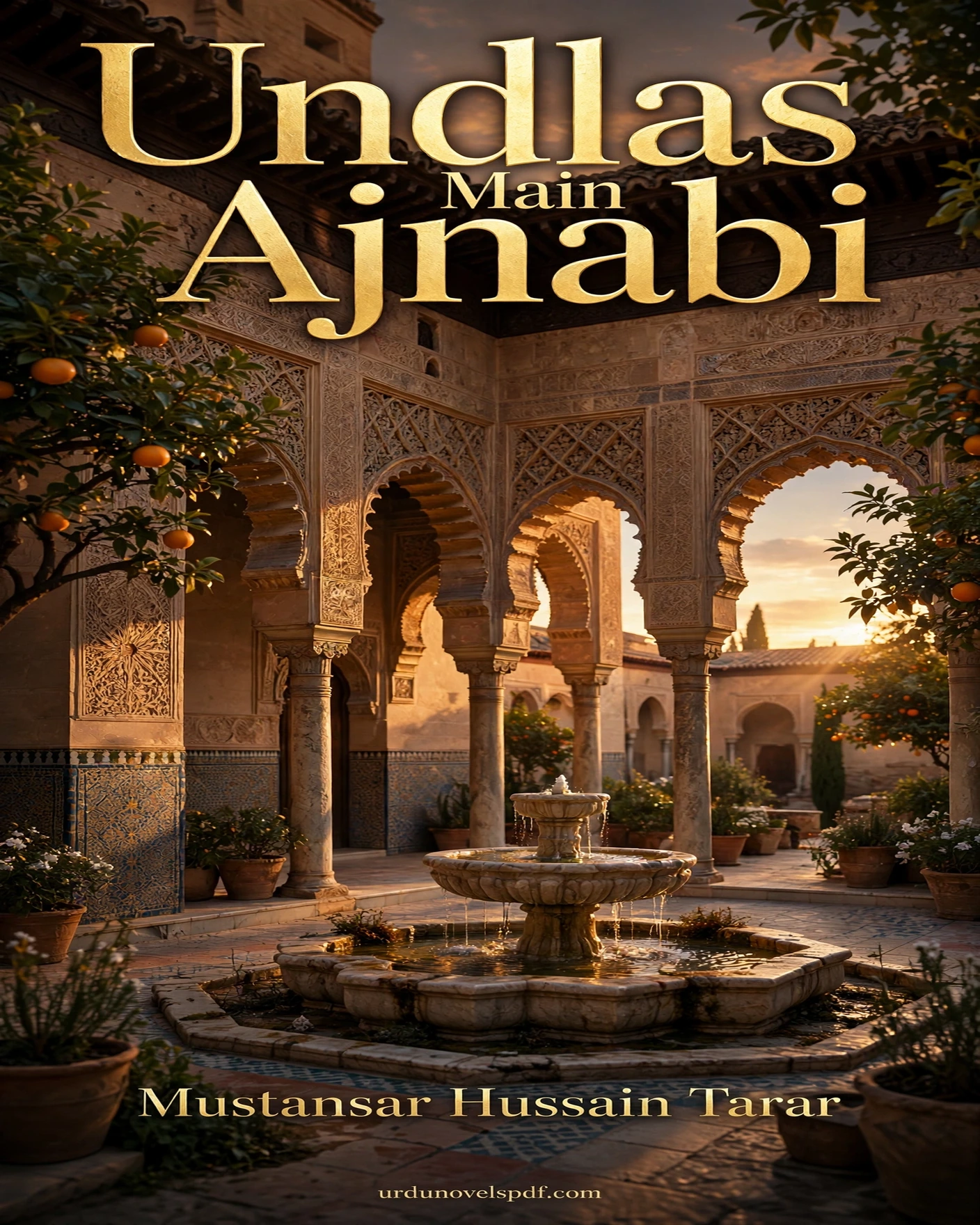
Undlas Main Ajnabi is a journey through Andalusia, the Spain of the imagination, as one modern travel writer called it: a sunlit southern land of orange trees, courtyards, flamenco music, and Moorish architecture.
The two names every reader should know are Cordoba and Granada.
Cordoba, called Qurtuba in the old sources, was once the capital of the Caliphate of Cordoba and one of the greatest cities of the medieval world, a city of books, scholars, and grand architecture.
Its Great Mosque, the Mezquita, with its forest of arches, still stands at the centre of the city, and it is the place Iqbal’s Masjid-e-Qurtuba made sacred for Urdu readers.
Granada, called Gharnata, was the last Muslim kingdom in Iberia, falling in 1492, and it is home to the Alhambra, the palace fortress whose carved walls, courtyards, and gardens are among the most famous examples of Islamic architecture in the world.
This page does not invent a chapter-by-chapter itinerary for the book, because the sources consulted for this page, including Rekhta’s ebook listing, literary profiles, and newspaper essays, describe the book’s subject and standing without publishing a detailed chapter list.
What can be said with confidence is what the book is about at its core: a traveller’s encounter with the surviving traces of al-Andalus, its mosques turned into churches, its palaces, its old quarters, its language and customs, and the long shadow of a civilization that flourished for nearly eight centuries and then ended.
Tarar writes about that encounter the way he writes about all his travels, through what he sees, whom he meets, what he remembers from his reading, and what he feels when the past and the present stand side by side in a single courtyard or street.
For a modern reader, that approach makes the book useful in two ways at once.
First, it is a piece of Urdu literature in its own right, worth reading for Tarar’s prose, humour, and eye for people.
Second, it is a gentle introduction to the history of Muslim Spain for readers who know the names but not the story: how Tariq ibn Ziyad crossed into Iberia in 711, how Cordoba rose to greatness, how the Christian Reconquista gradually retook the peninsula, and how Granada held out until 1492.
A reader who finishes Undlas Main Ajnabi will not only have enjoyed a travel book, they will also understand why Andalusia still moves Urdu readers so deeply, and why its monuments are treated almost like places of pilgrimage by visitors from Pakistan and the wider Muslim world.
Readers who enjoy classic Urdu prose may also like Zarguzasht by Mushtaq Ahmad Yousufi.
Themes in Undlas Main Ajnabi
Several themes run through Undlas Main Ajnabi, and they are the reason the book is discussed in university research as well as by ordinary readers.
The first is loss and memory.
Tarar is walking through a civilization that no longer exists politically, and every beautiful building carries the knowledge that the people who built it are gone.
That gives the book a melancholy tone that many readers find deeply moving, even when Tarar is being funny or light in a particular passage.
The second theme is identity.
The traveller is a stranger in Spain, but he is not a stranger to its history.
He recognises words, names, and stories that Spanish people around him may know only as local history, and that double position, insider to the past and outsider in the present, shapes everything he writes.
The third theme is encounter with the other.
Tarar meets Spanish people, observes their customs, food, music, and daily life, and compares them, sometimes sharply, with his own background.
Academic writing on the book, including a 2015 research paper on Andulus Mein Ajnabi, has discussed this aspect critically, arguing that Tarar sometimes presents Western culture through stereotypes.
Ordinary readers do not need to agree or disagree with that academic argument to enjoy the book, but it is worth knowing that the book is not a neutral guidebook.
It is one man’s honest, personal, and sometimes opinionated account, and part of its interest is seeing Spain through his particular eyes.
The fourth theme is beauty itself: architecture, gardens, light, music, and landscape, described with the delight of a man who loves beautiful things and wants his reader to see them too.
For another landmark work of classic Urdu literature, see Aangan by Khadija Mastoor.
Why You Should Read Undlas Main Ajnabi
There are several good reasons to read this book, and they suit different kinds of readers.
If you love Urdu literature, it is one of the essential travelogues by its most popular travel writer, and it shows Tarar’s style at its most emotional.
If you love history, it is the most readable introduction to Muslim Spain available in Urdu, written by someone who felt that history personally rather than merely studied it.
If you are planning a trip to Spain, especially to Andalusia, it will change how you see Cordoba and Granada, because you will arrive already knowing why those cities matter to millions of readers.
And if you simply enjoy good travel writing, it is a warm, funny, observant book about what it feels like to be far from home and yet strangely close to something you have loved all your life.
Undlas Main Ajnabi is also a good first Tarar travelogue for a new reader.
His northern Pakistan books assume a love of mountains and trekking, and his longer novels demand more patience, but this book needs only curiosity about history and a willingness to travel in imagination.
It is equally suitable for students of Urdu literature, who will find it discussed in essays and research on the safarnama tradition, and for casual readers, who will find it entertaining page by page.
That double appeal, scholarly and popular at once, is rare, and it explains why the book has stayed in print and in conversation for decades, with later editions and reprints keeping it available to each new generation of readers.
Another classic of Urdu literature is Alipur Ka Aili by Mumtaz Mufti.
How to Read Undlas Main Ajnabi Online and Download the PDF
You can read Undlas Main Ajnabi by Mustansar Hussain Tarar online or download the complete PDF using the buttons on this page.
Click Read Online to open the book in your browser, or click Download PDF to save the complete file to your phone or computer and read it offline at your own pace.
Both buttons use the same complete file supplied for this page.
The book is in Urdu, so it is best read on a device that displays Urdu script clearly, and the PDF format keeps the original layout intact on every screen.
If you are new to Urdu travelogues, a practical reading tip is to read this book slowly, a few chapters at a time, and to keep a map of Andalusia nearby, or to look up photographs of the Alhambra and the Mezquita as Tarar describes them.
The places are real and still standing, and seeing them while you read makes the book twice as vivid.
Teachers and parents also use this book to introduce young readers to Tarar, because it teaches history without feeling like a lesson, and it shows how travel can change the way a person understands their own culture.
Whether you read it for study, for a journey, or simply for pleasure, it rewards unhurried reading.
Frequently Asked Questions About Undlas Main Ajnabi
Download Undlas Main Ajnabi by Mustansar Hussain Tarar: Free PDF
Read or download Undlas Main Ajnabi by Mustansar Hussain Tarar complete for free.
Click the buttons above and your file will begin in 10 seconds.
Frequently Asked Questions
Is Undlas Main Ajnabi a novel or a travelogue?
Who wrote Undlas Main Ajnabi?
What does Undlas Main Ajnabi mean in English?
When was Undlas Main Ajnabi first published?
Is Undlas Main Ajnabi complete?
Is Undlas Main Ajnabi in Urdu or English?
What places does Undlas Main Ajnabi cover?
Which Mustansar Hussain Tarar book should I read after this one?
Where can I read Undlas Main Ajnabi for free?
Final Verdict
Undlas Main Ajnabi by Mustansar Hussain Tarar is essential reading for anyone who loves Urdu literature, history, or travel writing.
It is a real traveller’s encounter with a lost civilization that still stands in stone in Cordoba and Granada.
Read it slowly, look up the places as you go, and you will understand why this travelogue has stayed beloved for decades.
The complete book is available for free.
Click the Download or Read Online button above.
Start reading today.
For another landmark Urdu novel, see Khuda Ki Basti by Shaukat Siddiqui.


One Comment