Bajang Amad by Muhammad Khan – Complete PDF Download
urdunovelspdf.com
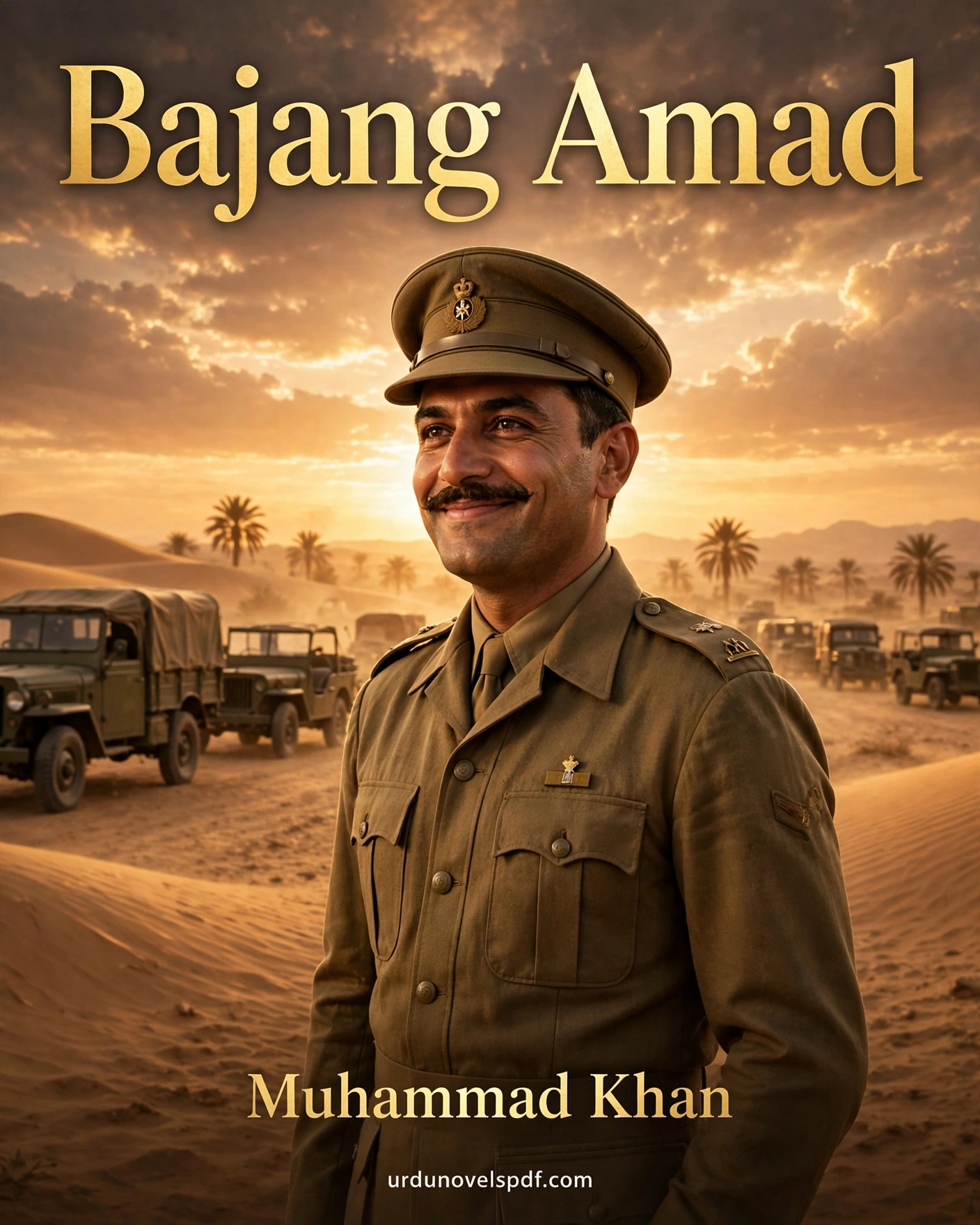
Bajang Amad by Muhammad Khan is one of the funniest and most famous books in Urdu literature, and it is also one of the most misunderstood by new readers.
Search results file it among Urdu novels, but that is not quite right.
Bajang Amad by Muhammad Khan is not a made-up story with a hero, a heroine and a love plot.
It is a humorous autobiographical memoir: the true story of a young officer’s life in the army during the Second World War, told by the man who lived it.
If you want to laugh, and at the same time understand what soldiering, the British Raj and the Middle East looked like in the 1940s, this is the book to start with.
Please note first of all that, on this site too, it is presented honestly as a memoir, not as a romance novel.
Quick Answer: Bajang Amad is Colonel Muhammad Khan’s humorous memoir of his Second World War army service, first published in 1966.
On Urdu Novels PDF you can read it online and download the complete PDF using the buttons below.
| Book Details | Information |
|---|---|
| Book Name | Bajang Amad (بجنگ آمد, also spelled Bajang Aamad / Bajung Aamad) |
| Author/Writer Name | Muhammad Khan, widely known as Colonel Muhammad Khan (born Muhammad Khan) |
| Genre | Humorous autobiographical memoir, war memoir, classic Urdu humour |
| First Published | 1966; about 224 pages |
| Language | Urdu |
| Status | Complete book |
| Availability | Read Online and Complete PDF Download |
Bajang Amad by Muhammad Khan: What Kind of Book Is It?
The first thing to get straight is the form, because it decides whether you will enjoy the book.
A novel invents characters and a plot.
Bajang Amad invents nothing.
It is the author’s own memory of his army years, written with a humorist’s eye.
That is why it reads so easily: every scene is a real place, a real posting, a real absurdity of army life, and the joke is that the author refuses to take even danger too solemnly.
Readers who open it expecting a romance will be surprised.
Readers who open it expecting to laugh, and to learn something about the 1940s on the way, will not be disappointed.
The title itself tells you the subject.
Bajang Amad (بجنگ آمد) literally means “coming to war” or “arrived for battle”: ba-jang means “to war”, and aamad means “coming” or “arrival”.
You will also see the title spelled Bajang Aamad and Bajung Aamad.
All three spellings are the same book by the same author, so if you searched with a different spelling and landed here, you are in the right place.
There is one more warning worth giving honestly.
This is a book of episodes, not one long story with a climax.
The author moves from training to one posting and then another, and each posting brings its own people, problems and jokes.
You can read it straight through, or dip into it in any order, and you will not get lost.
That episodic shape is exactly what makes it such a good bedside book and such a good gift for a reader who is new to classic Urdu prose.
The Journey in Bajang Amad
The narrative begins in January 1940, when the young Muhammad Khan joins the British Indian Army in the subcontinent.
The training chapters are many readers’ favourites, because they describe the feelings of a cadet under training with complete honesty: the fear, the pride, the strict officers, the fellow cadets, and the small daily humiliations that later become the best stories.
Readers often compare this part of the book to the army-training humour of Shoaib Mansoor’s “Alpha Bravo Charlie” and “Sunehry Din”, and the comparison is fair: the same mix of discipline and comedy, remembered by a man who lived through it.
On completing his training he was commissioned as a second lieutenant and soon made lieutenant.
His first active posting took him to the area near Bannu, to face Mirza Ali Khan, popularly known as Faqir of Ipi, the legendary freedom fighter who was waging guerrilla warfare against the British.
Here the book shows its other face.
The humour never leaves, but the reader also sees a young Indian officer caught between his uniform and his own people, fighting a man many locals admired.
Colonel Muhammad Khan does not preach about this dilemma.
He lets the comedy and the discomfort sit side by side, which is why the passage still feels modern.
Then the Second World War carries him to the Middle East: to Basra and Iraq, to Egypt and Cairo, to Palestine and the Western Desert of Libya, where he served against the Germans, in some accounts as a signals officer.
These are the chapters that made the book famous.
Desert marches, strange towns, foreign languages, supply shortages, senior officers with fixed ideas, and ordinary soldiers finding jokes in miserable conditions: the author turns all of it into comedy without hiding the hardship.
Between the jokes he keeps showing the grim side of war as well, so that a serious message arrives in a light manner and stays with you longer than a lecture would.
After the war ended, the journey did not end at once.
Dawn’s account of the author’s life records that he was sent to Cairo and later posted in Burma (now Myanmar), and the memoir records the memories of those days of training, travel and soldiering.
Sources name the Middle East postings in slightly different orders, so this page does not pretend to a chapter-by-chapter map that no source supports.
What every source agrees on is the shape of the story: a young man from a Chakwal village becomes an officer, sees the last years of the British Raj from inside its army, and comes home with a book that made a whole country laugh.
Why Bajang Amad Became So Famous
Bajang Amad was an overnight, smashing success when it appeared in 1966, and it stayed one of the best-selling Urdu humour books from the late 1960s through the 1980s.
That is a rare fate for a first book, and it happened because the author was not a professional writer imitating humour.
He was a soldier who happened to see life humorously.
The great humorists of Urdu welcomed him at once: Mushtaq Ahmad Yusufi, Zamir Jafri, Shafiq-ur-Rahman, Ibn-e-Insha, Muhammad Khalid Akhter and Rasheed Ahmed Siddiqi were all, in Dawn’s words, pleasantly surprised to discover that a first-time author was so talented, and they welcomed him with open arms.
What made the book last is the quality of the humour itself.
Dawn’s headline for the author calls it a humour that could “laugh at misery”.
The jokes are not one-liners pasted onto a story.
They come from witty repartees, from an unusual perspective on misfortune, and from a man who describes even an encounter with Faqir of Ipi and the events of the Second World War as if they were a comic excursion.
Zamir Jafri’s Urdu praise, quoted on Goodreads, compares the author’s humour to a stream laughing, smiling and humming as it flows through a beautiful valley, carrying its banks along with it.
The author was also a great admirer of Ghalib, and his use of Ghalib’s couplets in the book gives readers who know those couplets an extra layer of pleasure.
There is also a historical reason to read it now.
The book is a window onto the last days of the British Raj, the struggles of locals under British rule, and questions of language, culture and independence, all handled in a very human way rather than as a textbook.
One reviewer notes that while weapons and technology have changed, some of the book’s observations, about trouble in Waziristan and Western interference in the Middle East, feel strangely unchanged.
That is why teachers, students and general readers keep returning to it: it is funny first, and it teaches without ever sounding like a lesson.
Another essential classic, Raja Gidh by Bano Qudsiya, is also available on this site.
About the Author: Muhammad Khan, the Colonel
Here is the name question, answered plainly, because it confuses many searchers.
The author’s birth name was Muhammad Khan.
He is mostly known as Colonel Muhammad Khan to distinguish him from other bearers of this very common name, and because he was a colonel in the Pakistan Army when his first book appeared.
When he later dropped the title “Colonel” from his books and they began to appear under just “Muhammad Khan”, readers did not like it.
They wrote letters saying the name somehow looked incomplete, and on their protest he restored the rank.
Later editions again show just “Muhammad Khan”.
Both names are the same man, and this page uses “Muhammad Khan” in its title, as the publishing queue directs, while giving him his full “Colonel Muhammad Khan” credit here in the body.
He was born on 5 August 1910 in Balkasar, a village in Chakwal district, Punjab.
After middle school in his village he went to Chakwal for matriculation, where the well-known writer Ghulam Jeelani Barq taught him Urdu and Persian, and he studied classical Urdu poetry deeply.
He later took a Bachelor of Arts degree from Islamia College, Lahore, and a Master’s degree from Punjab University.
He began writing in Chakwal as a poet under the pen name Sadiq, then gave up poetry and wrote prose only.
Before the army he worked briefly as a sports writer for Eastern Times, published by Ferozsons, Lahore, and then as a college lecturer.
The Second World War changed his life: he joined the British Indian Army, and after Independence he was absorbed into the Pakistan Army, rising to colonel.
He died on 23 October 1999 in Rawalpindi and was buried in his hometown in Chakwal.
His later books are worth knowing so that you do not confuse them with this one.
Basalamat Ravi (1975) is the travelogue of his 1974 tour of England, and it is, by the same accounts, just as hilarious as Bajang Amad, with humour that begins even before the journey starts.
Bazam Arayan (1980) is a collection of assorted prose pieces, some of them a little more serious and thought-provoking.
Badesi Mazah (1992) adapts English humorous pieces into Pakistani dress; these are adaptations, not straight translations.
None of them replaces Bajang Amad.
It remains his first book, his most famous book, and the one that made him one of the most influential humorists in Urdu, alongside Yusufi, Zamir Jafri and Shafiq-ur-Rahman.
Who Should Read Bajang Amad, and How
This book suits readers who like humour with substance.
If you enjoy Urdu humour, army stories, memoirs, or books about the 1940s and the end of the Raj, start here.
Students of Urdu literature will find it especially useful: it is the classic example of modern Urdu humour, short enough to read completely, rich enough to quote, and written in a style that rewards slow reading.
Readers who loved Zarguzasht or other classic Urdu humour will recognise the same tradition here, told from inside a uniform rather than from a drawing room.
One honest language note belongs here.
Some words in the book are difficult for the average modern Urdu speaker, and the book itself helps: there are footnotes at the bottom of pages, and a dictionary (lughat) clears up the rest.
Do not let that put you off.
The difficult words are part of the book’s charm, and the humour carries you past them.
Read one posting at a time, enjoy each episode on its own, and do not rush.
This is not a book to finish in a night and forget.
It is a book to keep, lend, and re-read, which is exactly what generations of readers have done since 1966.
Finally, a note for readers who came here from a romance-novel search.
Bajang Amad has no fictional love story, and this page does not invent one for it.
What it has instead is something rarer: a real man’s real war, told so funnily that the war itself becomes bearable, and so honestly that the laughter means something.
If that sounds like your kind of book, use the buttons above and start reading.
For another classic family story from Urdu literature, see Aangan by Khadija Mastoor.
Which Book Is Which? Bajang Amad and the Author’s Other Books
| Book Details | Information |
|---|---|
| Bajang Amad (1966) | Humorous Second World War memoir. This book, the author’s first and most famous work. |
| Basalamat Ravi (1975) | Travelogue of the author’s 1974 tour of England. Equally humorous, but a travel book, not a war memoir. |
| Bazam Arayan (1980) | Collection of assorted, partly semi-autobiographical prose pieces. Some pieces are more serious. |
| Badesi Mazah (1992) | English humorous pieces adapted into Pakistani dress. Adaptations, not a memoir. |
Key Facts
- Bajang Amad is a humorous autobiographical memoir, not a fictional novel.
- Author: Muhammad Khan, widely known as Colonel Muhammad Khan (1910-1999).
- First published 1966; about 224 pages; one of the best-selling Urdu humour books of the late 1960s to 1980s.
- Journey: training from January 1940, Bannu and Faqir of Ipi, then Basra/Iraq, Egypt/Cairo, Palestine and the Western Desert (Libya) in the Second World War, then Cairo and Burma after the war.
- Title means “coming to war” (بجنگ آمد); also spelled Bajang Aamad and Bajung Aamad.
- Humour style: witty repartees, laughing at misery, Ghalib couplets, grim facts inside jokes.
- Other books: Basalamat Ravi (1975), Bazam Arayan (1980), Badesi Mazah (1992).
Frequently Asked Questions
Is Bajang Amad a novel?
Who wrote Bajang Amad, Muhammad Khan or Colonel Muhammad Khan?
Are Bajang Amad, Bajang Aamad and Bajung Aamad the same book?
What is Bajang Amad about?
Is Bajang Amad funny or serious?
How many pages is Bajang Amad, and is it complete?
Is Bajang Amad good for students?
What should I read after Bajang Amad?
Final Verdict
Bajang Amad by Muhammad Khan is not a novel, and it is better for it.
It is a real soldier’s real war, remembered by a man who could laugh at misery, quote Ghalib in a desert, and make a whole country laugh at its own army days.
First published in 1966, it has outlasted fashions because its humour is honest and its history is lived, not borrowed.
For any reader of Urdu literature, it is essential reading, and for a new reader it is the friendliest possible doorway into classic Urdu humour.
For another landmark of classic Urdu literature, Khuda Ki Basti by Shaukat Siddiqui is also available on this site.
The complete book is available here.
Click the Read Online or Download PDF button above to start reading Bajang Amad today.