Maan Ji by Qudratullah Shahab – Complete PDF Download
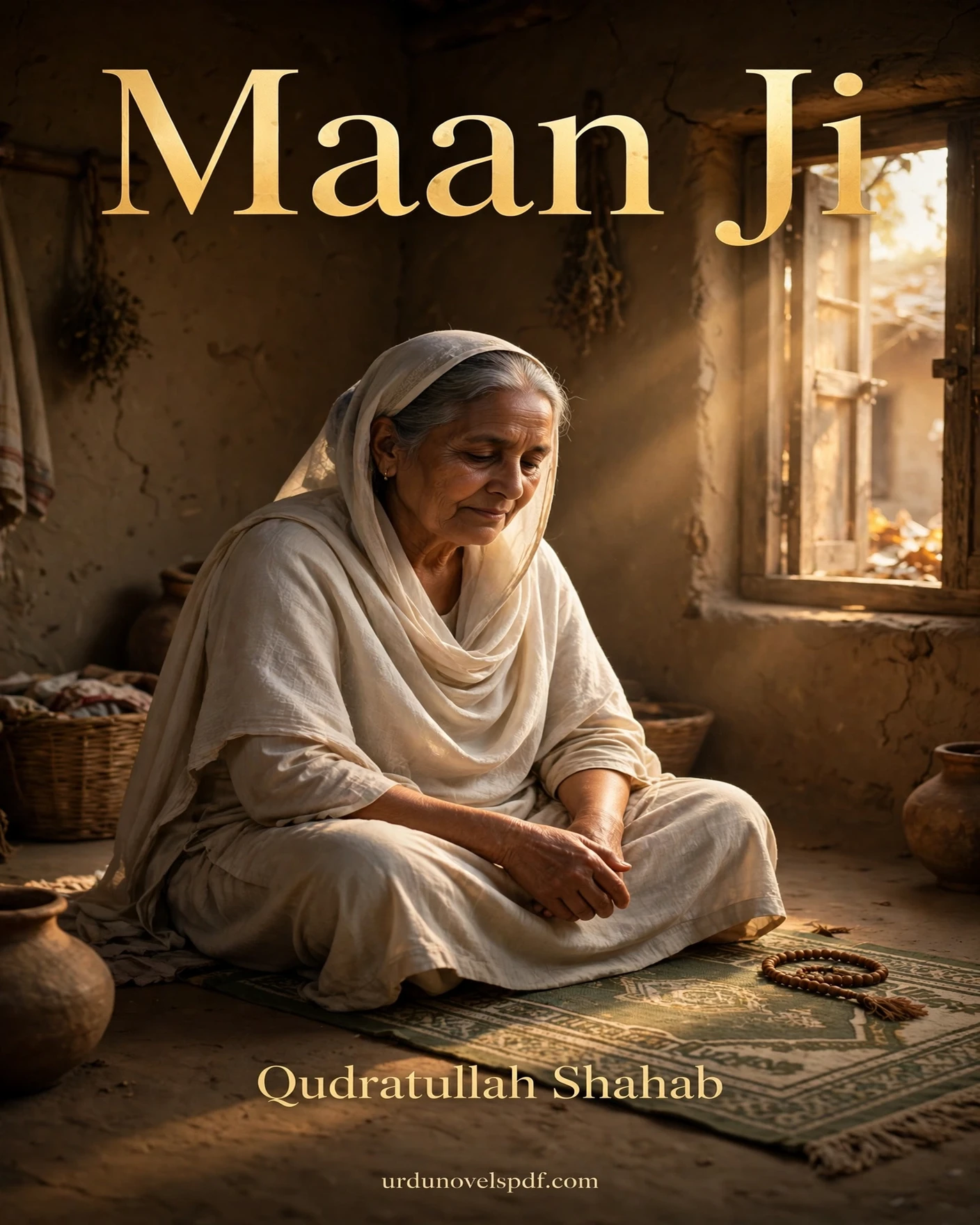
urdunovelspdf.com
Maan Ji by Qudratullah Shahab is one of the most loved Urdu books about a mother, and this page gives you the complete book to read online and download as a PDF, together with an honest guide to what the book actually is, what its famous title story says, and why readers still return to it.
If you came here expecting a long romantic novel with a hero and a heroine, stop for a moment, because that expectation will mislead you.
Maan Ji is not that kind of book at all, and understanding its real form is the first step to enjoying it.
The book is a collection of short stories, written in Urdu, and its title story is a tender, memory-filled portrait of the author’s own mother.
This guide keeps every claim close to what the sources actually say, and it says plainly where the sources disagree, so you are never sold a confident story that the evidence does not support.
Quick Answer: Maan Ji (Urdu: ماں جی) is a short-story collection by Qudratullah Shahab, not a novel.
Its title story, Maaji, is about his mother, a simple, devout woman whose whole life was service to her family, and the collection is best read one story at a time, starting with that title story.
Key Facts
- Form: a short-story collection (afsane), not a novel, and not a single short story on its own.
- Author: Qudratullah Shahab, Urdu writer, civil servant and diplomat, best known for his autobiography Shahab Nama.
- Language: Urdu, with an English translation of the title story by Shafique N. Virani.
- Title story: Maaji, the first story of the book, about the author’s mother, a portrait of simplicity, devotion and faith.
- Title meaning: Maan Ji means respected mother, a term of love and honour for a mother.
- Goodreads listing: genre Short Stories and Fiction, with a first-published date listed as 1968 and a hardcover edition of 215 pages.
- Companion works: Shahab Nama (autobiography), Ya Khuda (novel), Surkh Feeta and Nafsane (short-story collections).
- Reading time: the collection suits slow, one-story-at-a-time reading, and the title story can be finished in a single sitting.
| Book Name | Maan Ji (Urdu: ماں جی, also spelled Maan Jee, Maa Ji, Maaji) |
| Author / Writer Name | Qudratullah Shahab |
| Genre | Short stories (afsane), with memoir-like writing in the title story |
| Form | Short-story collection, not a novel |
| First Published (as listed) | Goodreads lists 1968; edition dates vary, so no single first-edition year is asserted here |
| Status | Complete collection |
| Language | Urdu |
| Title Story | Maaji, about the author’s mother |
| Availability | Free PDF Download and Read Online |
Maan Ji by Qudratullah Shahab: What the Book Actually Is
The most important fact about Maan Ji is also the fact most download pages get wrong, so it deserves to be said first and plainly.
Maan Ji is a collection of short stories.
It is not a novel, it has no chapters following one hero and heroine through a long love story, and it should not be judged by the rules of a novel.
Each story stands on its own, with its own people and its own moment, and the pleasure of the book comes from moving slowly from one small, complete world to the next.
The book takes its name from its very first story, Maaji, and that choice tells you what Shahab valued most in the collection.
Reviewers on Goodreads note the same point, that the first story gives the whole book its name, and that the title story in particular is praised by readers as one of the finest pieces in it.
Shahab’s own later fame rests on a much bigger book, Shahab Nama by Qudratullah Shahab, his autobiography, but Maan Ji shows the same writer working at a smaller, more intimate scale, where a mother’s daily habits matter as much as any great event.
Wikipedia’s book list classifies Maan Ji under short stories, and the same list places Surkh Feeta and Nafsane beside it as further short-story collections.
Rekhta, the Urdu literature archive, likewise lists Maan Ji among Shahab’s short stories, alongside other short pieces of his.
No reliable listing calls Maan Ji a novel, and this page does not do so either, even though the post title follows the house pattern used for novels.
The Title Story Maaji: A Mother Remembered in Small Details
Maaji is the heart of the book, and it is best understood as a portrait rather than a plot.
There is no twist to spoil and no villain to defeat, because the story’s power lies in accumulation, in small observed facts that build, one by one, into a whole life.
Wikipedia describes the piece as poetically outlining the simplicity of Shahab’s mother and the relationship his parents shared, touching on migration, family life and death in a short chapter.
The English translation by Shafique N. Virani, published in The Annual of Urdu Studies in 2004, lets non-Urdu readers see exactly how Shahab builds the portrait.
The mother, whom the translation calls Mamma, was probably born in the last ten or fifteen years of the nineteenth century, and her ancestral home was Manila, a village in the Rupar division of Ambala district in eastern Punjab.
When a new colony was established in the Baar region of Lyallpur district, offering free land to settlers, her family gathered itself together and moved there, a migration that shaped the rest of her life.
What readers remember most, though, is not the geography but the inventory of a life lived with almost nothing.
At her death, a few small coins were found tied in a muslin handkerchief at the head of her bed, saved, as the family understood it, to light the lamp on a Thursday evening.
Her whole possessions, as the translation lists them, were three sets of cotton clothes, a pair of country shoes, a pair of rubber slippers, her reading glasses, a ring set with three small turquoise stones, a prayer mat, a string of prayer beads, and nothing else besides God’s name.
One outfit she wore, a second she washed with her own hands and kept under her pillow so that it stayed pressed, and a third stood ready for the wash.
She never felt the need for a suitcase, because a small bundle was always enough for her, even for the longest journey.
The mother in Maaji does not preach about contentment, and Shahab does not lecture the reader about it either.
Goodreads reviewers echo this reading in their own words, calling the book a heart-touching tale of simplicity and praising its sweet, refreshing short stories.
The Rest of the Collection: Other People, Other Lives
Beyond the title story, Maan Ji gathers further short stories in which Shahab turns the same attentive eye on other people.
One story discussed in reference writing about the collection is Stenographer, the story of Gracie, an Anglo-Indian girl whose command of English shapes her working life.
That single example shows the collection’s range: from a Punjabi village mother to a young woman navigating a very different, English-speaking world of offices and employment.
Shahab’s style, in this reading, is not didactic in the scolding sense, even though his purpose is moral in the deeper sense of paying attention to how people actually live.
A reader who enjoys this kind of short, humane portrait may also enjoy Manto Nama by Saadat Hasan Manto, another landmark Urdu short-story collection, though Manto’s satire is sharper and darker than Shahab’s gentler tone.
It is honest to add that the collection divides opinion, and a good guide should not hide that.
Some Goodreads reviewers give it the highest praise and say they have read it many times, while at least one critical reviewer finds some stories too blunt and detects the influence of Manto in them.
Themes in Maan Ji: What the Stories Keep Returning To
A mother’s devotion, without sentimentality
The first theme is a mother’s devotion, presented without sentimentality and without exaggeration.
Her devotion is visible in routine, not in speeches, and that is why the portrait feels true rather than decorated.
Simplicity against power and position
The second theme is simplicity set against power and position, and it gains force from who Shahab himself was.
He spent his working life near the very centre of power, yet the book he named for his mother honours a woman who owned almost nothing and wanted almost nothing.
A similar contrast between ordinary lives and great events runs through Khaak aur Khoon by Naseem Hijazi, though that historical novel works on a far larger canvas than these short stories.
Migration, memory and home
The third theme is migration, memory and home, the movement from an ancestral village to a new colony, and the way a home is carried in habits rather than in houses.
The mother’s life spans that move, from Manila to the Lyallpur colony, and her readiness to travel with a small bundle becomes a quiet image of what home meant to her.
Faith as daily practice
The fourth theme is faith as daily practice rather than as display.
Faith, for the mother in Maaji, is part of the furniture of an ordinary day, like washing clothes and lighting a lamp, and Shahab presents it in exactly that unshowy way.
Readers who value that reflective, unshowy mode of writing may also find it in Dil Darya Samandar by Wasif Ali Wasif, a collection of reflections rather than a novel, though Wasif Ali Wasif’s voice is his own.
Qudratullah Shahab: The Civil Servant Who Wrote
Qudratullah Shahab lived two lives at once, and Maan Ji makes more sense when both are kept in view.
He was an eminent Urdu writer, civil servant and diplomat from Pakistan, and he remains best known for his autobiography Shahab Nama.
At the same time he was a man who rose to the highest offices of the state, serving as Principal Secretary to three heads of state, Governor General Ghulam Muhammad, President Iskander Mirza and President Ayub Khan.
He later served as Pakistan’s Ambassador to the Netherlands in 1962, and as Information Secretary and Education Secretary, before resigning during the Yahya Khan period.
He was born in Gilgit, the son of Abdullah Sahib, who belonged to a Punjabi family of Chamkaur Sahib village in Ambala district and had settled in Gilgit after studying at Aligarh.
At sixteen, an essay of Shahab’s won the first prize in an international competition organised by Reader’s Digest in London, an early sign of the writer inside the future official.
In 1941 he became the first Muslim from Jammu and Kashmir to qualify for the Indian Civil Service, and after Partition in 1947 he moved to Karachi and served the new state of Pakistan, including as the first Secretary General of the Azad Jammu and Kashmir government and as Deputy Commissioner of Jhang.
His later years took a spiritual turn that readers of Shahab Nama know well, and writers such as Mumtaz Mufti and Bano Qudsia wrote books about his personality and mysticism after his death.
He died on 24 July 1986 in Islamabad and is buried in the H-8 Graveyard there, and in 2013 Pakistan Post honoured him with a Rs 15 stamp in its Men of Letters series.
His birth year is one of the facts on which sources disagree, with Wikipedia giving 26 February 1917 and Pakistani press obituaries giving 1920, so this page gives his birthplace and death date, which are not in dispute, and asserts neither birth year as settled.
Maan Ji, Shahab Nama, Ya Khuda and Surkh Feeta: Do Not Confuse Them
Because Shahab’s books share an author and sometimes a shelf, searchers often confuse them, and a clear separation saves wasted reading.
Shahab Nama is his autobiography, published after his death, a very long book of over a thousand pages covering his childhood, education, civil service career, and spiritual experiences.
It is the book for which he is most famous, and it is a different book from Maan Ji in every way that matters: length, form and purpose.
If you want Shahab’s life story, read Shahab Nama, and if you want his short fiction, begin with Maan Ji.
Ya Khuda is a separate work again, listed as a novel, and described in reference writing as a short novel on the subject of riots.
It belongs to the next item in this publishing programme, and it should not be treated as part of Maan Ji or as an alternative title for it.
Surkh Feeta, meaning Red Tape, and Nafsane are further short-story collections by Shahab, and they sit beside Maan Ji on his bibliography rather than inside it.
For readers coming from the classic Urdu novel tradition, the contrast is instructive, because a family saga such as Aangan by Khadija Mastoor builds its effect over hundreds of pages and many characters, while a Maan Ji story builds its effect in a few pages around a single remembered person.
Neither form is better in itself, but they ask for different kinds of attention, and Maan Ji rewards the reader who is willing to slow down.
How to Read Maan Ji: A Simple Reading Order
Start with the title story, Maaji, and read it in one sitting, without hurrying past the small details.
The coins in the handkerchief, the three outfits, the prayer mat and the bundle for travelling are not decoration, they are the story, and they repay a second reading once you know how the portrait ends.
After that, read one further story at a time, with a gap between stories, rather than rushing through the collection as if it were a novel to be finished.
In Maaji the answer is the handkerchief and the three outfits, and in other stories the answer will be different, but the method is the same.
The same one-story-at-a-time habit also suits Zarguzasht by Mushtaq Ahmad Yousufi, a collection of humorous essays and sketches, though Yusufi’s comedy is very different from Shahab’s quiet portraiture.
Who Should Read Maan Ji, and Who Should Choose Something Else First
Maan Ji suits readers who love Urdu short stories, readers who want to understand Shahab beyond Shahab Nama, and readers looking for a book about mothers that is honest rather than sentimental.
It suits students of Urdu literature who need a clear example of the afsana as a form, and it suits general readers who want a short, meaningful book rather than a long commitment.
It suits less well readers who want a fast romantic novel, a thriller, or a book with a single long plot and a dramatic ending.
Such readers will be disappointed if they judge a short-story collection by novel standards, and they would do better to begin elsewhere.
A reader in that mood might prefer a contemporary romantic novel such as Teri Yaad Khaar-e-Gulaab Hai by Umera Ahmed, a short story by Umera Ahmed, or a full-length family novel, and return to Maan Ji when they want something quieter.
How to Read Online and Download the Maan Ji PDF
Use the buttons on this page to read Maan Ji online or to download the complete PDF.
The Read Online button opens the book for reading in your browser, and the Download PDF button saves the complete collection to your device for offline reading.
Both buttons use the same complete file, so choose whichever suits your reading habit, and keep the file for re-reading, because this is a book that improves on a second visit.
Readers who enjoy classic Urdu writing in this reflective mode may also enjoy Dil Se Niklay Hain Jo Lafz by Farhat Ishtiaq, a collection by Farhat Ishtiaq, though its voice and subject are entirely its own.
A genuine Maan Ji file is a short-story collection whose first story is about the author’s mother, and any file that opens as a long autobiography or a novel about riots is a different book.
Maan Ji by Qudratullah Shahab: Frequently Asked Questions
Is Maan Ji a novel?
No, Maan Ji is not a novel.
It is a short-story collection by Qudratullah Shahab, written in Urdu.
Its title story, Maaji, is about the author’s mother, and the other stories are separate short pieces, not chapters of one long novel.
What is Maan Ji about?
Maan Ji is a collection of short stories, and its title story is a portrait of the author’s mother.
That portrait follows a simple, devout woman from her ancestral village through migration to the Lyallpur colony, and it remembers her through small details: three cotton outfits, a prayer mat, prayer beads, a ring, and a few coins saved for lighting a lamp.
The other stories look at other ordinary people with the same quiet attention.
Who wrote Maan Ji?
Maan Ji was written by Qudratullah Shahab, an Urdu writer, civil servant and diplomat from Pakistan.
He is best known for his autobiography Shahab Nama, and he also wrote the novel Ya Khuda and the short-story collections Surkh Feeta and Nafsane.
He served as Principal Secretary to three heads of state and as Pakistan’s Ambassador to the Netherlands.
What does Maan Ji mean?
Maan Ji means respected mother in Urdu.
It is a term of love and honour for a mother, and Shahab gave the whole collection the name of its first story, which is about his own mother.
The spelling varies in listings as Maan Jee, Maa Ji and Maaji, but all three refer to the same book.
When was Maan Ji first published?
Goodreads lists Maan Ji as first published in 1968, and lists a hardcover edition of 215 pages.
Edition dates vary across listings, so this page reports the Goodreads listing rather than asserting one first-edition year as settled fact.
The English translation of the title story by Shafique N. Virani appeared in The Annual of Urdu Studies in 2004.
How many pages is Maan Ji?
Page counts depend on the edition.
One hardcover edition listed on Goodreads runs to 215 pages.
Other editions may differ, so a single page count should not be treated as true of every printing.
Is the title story Maaji a true story?
Maaji blends lived memory with literary shaping, and readers describe it as an amalgamation of fiction and reality.
Wikipedia describes it as an essay-like piece outlining his mother’s simplicity and his parents’ relationship, while the book as a whole is classified as short stories.
This page therefore calls it a memoir-like title story inside a short-story collection, rather than a documentary record or a purely invented tale.
What is the story Stenographer in Maan Ji?
Stenographer is a story discussed in reference writing about the Maan Ji collection.
It tells of Gracie, an Anglo-Indian girl whose command of English shapes her working life.
It shows the collection’s range beyond the title story, from a Punjabi village mother to a young woman in an English-speaking working world.
How is Maan Ji different from Shahab Nama?
Shahab Nama is Shahab’s autobiography, published after his death, running to over a thousand pages about his life, career and spiritual experiences.
Maan Ji is a much shorter short-story collection, named for a story about his mother.
They share an author and a concern with memory, but they are different books in form, length and purpose.
How can I read or download the complete Maan Ji PDF?
Use the Read Online and Download PDF buttons on this page.
Read Online opens the complete collection in your browser, and Download PDF saves it to your device for offline reading.
Check that the file you open is the short-story collection beginning with the story about Shahab’s mother, so you do not mistake Shahab Nama or Ya Khuda for this book.
What should I read after Maan Ji?
After Maan Ji, Shahab Nama is the natural next step for readers who want Shahab’s full life story.
Readers who want more Urdu short stories may turn to Manto’s collections, and readers who want a reflective, non-novel book may enjoy Wasif Ali Wasif’s reflections.
Read one story or section at a time in each case, because all of these books reward slow reading.
Is Maan Ji suitable for students?
Yes, Maan Ji is suitable for students of Urdu literature, especially as an example of the afsana and of memoir-like short writing.
The title story is short enough for classroom discussion, and its themes of motherhood, simplicity, migration and faith give plenty to discuss without needing a long novel.
Students should still note the form honestly in essays: it is a short-story collection, not a novel.
Read it slowly, begin with Maaji, and let each story leave its one clear image behind.
That is the reading the book asks for, and it is the reading it repays.