Aur Talwar Toot Gai by Naseem Hijazi – Complete PDF Download
urdunovelspdf.com
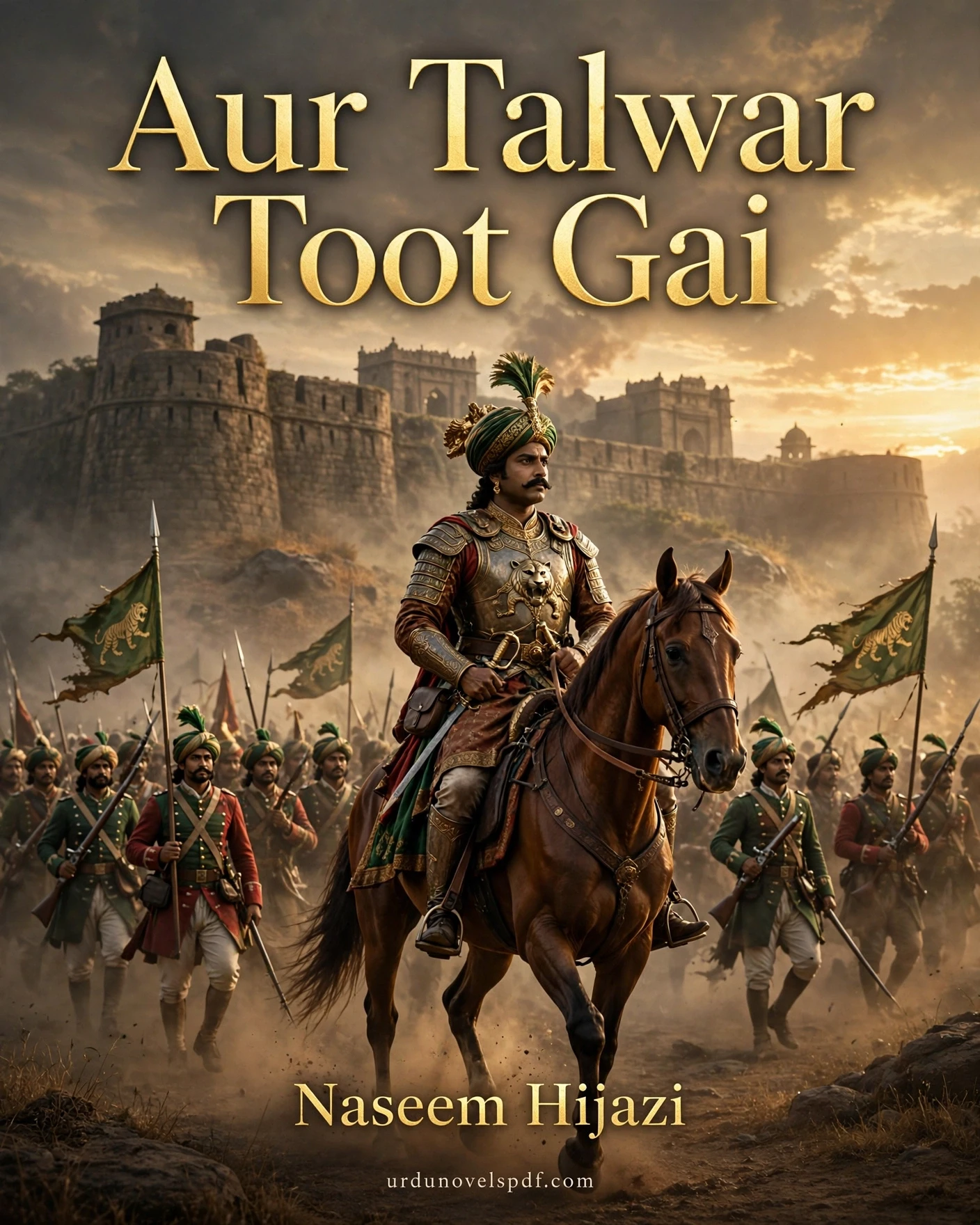
Aur Talwar Toot Gai by Naseem Hijazi is one of the most powerful historical novels in Urdu, and this page gives you the complete novel to read online and download as a PDF, together with an honest guide to what it actually is, what period it covers, and why it still matters today.
Before you download anything, one fact matters more than any other.
This is not a love story.
There is no romantic hero waiting in the next chapter, no heroine, no love triangle, and no plot twist about a relationship to spoil.
Aur Talwar Toot Gai is a historical novel about war, freedom and sacrifice in 18th-century India, about Tipu Sultan of Mysore and his struggle against the British East India Company.
The title itself tells you the subject.
Aur means and, or yet, talwar means sword, and toot gai means broke.
In English the title is often rendered as And the Sword Broke.
One more fact belongs at the very top, because several download sites get it wrong.
This novel is not about the creation of Pakistan.
Tipu Sultan died in 1799, nearly a hundred and fifty years before Pakistan came into being in 1947, and this book is about his Mysore, his wars and his martyrdom, not about 1947 at all.
Quick Answer: Aur Talwar Toot Gai by Naseem Hijazi is a complete historical Urdu novel, the sequel and second part of Muazzam Ali. It tells the story of Tipu Sultan of Mysore, the Lion of Mysore, and his wars against the British East India Company in the Anglo-Mysore Wars, ending in his martyrdom. Reference tables list the novel as published in 1964, in 4 editions, and some listings divide it into two volumes. It is a novel about war, freedom, unity and sacrifice, not a romance, and not a book about the creation of Pakistan. Read it online or download the complete PDF using the buttons on this page.
Key Facts
- Book: Aur Talwar Toot Gai, Urdu title اور تلوار ٹوٹ گئی, English rendering And the Sword Broke.
- Author: Naseem Hijazi, the pen name of Sharif Hussain (1914 to 1996).
- Genre: historical novel, not a romance novel and not a love story.
- Place in the author’s work: the sequel to Muazzam Ali, the second of Hijazi’s two novels on British India.
- Historical setting: Mysore in South India, the age of the Anglo-Mysore Wars, the late 18th century.
- Central figure: Tipu Sultan, son of Haider Ali, the Lion of Mysore.
- Fictional thread: Muazzam Ali, the lead character of the first book, carries over into this book.
- First published: 1964 according to reference tables, in 4 editions; some listings divide the novel into two volumes.
- Language: Urdu, in Hijazi’s direct and stirring narrative style.
- Availability: complete PDF download and read online on this page.
| Novel Details | Information |
|---|---|
| Novel Name | Aur Talwar Toot Gai |
| Author Name | Naseem Hijazi (Sharif Hussain) |
| Novel Genre | Historical, Islamic history, war and freedom struggle |
| Historical Period | Anglo-Mysore Wars, Tipu Sultan era, late 18th century |
| Setting | Mysore and Srirangapattana (Seringapatam) in South India |
| Central Figure | Tipu Sultan, the Lion of Mysore, son of Haider Ali |
| Fictional Thread | Muazzam Ali, the lead character of Muazzam Ali, carries over |
| Sequel Of | Muazzam Ali by Naseem Hijazi (read it first for the full story) |
| First Published | 1964 according to reference tables, 4 editions |
| Volumes | Listed in two volumes (Volume 1 and Volume 2) in some listings |
| Novel Status | ✅ Complete |
| Language | Urdu |
| Availability | Free PDF Download and Read Online |
What Kind of Book Is Aur Talwar Toot Gai?
Aur Talwar Toot Gai is a historical novel.
That single sentence is the most important thing on this page, because several websites file the book under labels that do not fit it at all.
Its first half is Muazzam Ali, and this book continues that story into the age of Tipu Sultan.
Together the two novels trace one long arc: the weakening of the old order in India after the Mughal Empire, the rise of the British East India Company, and the last great resistance offered to it by an Indian ruler.
Aur Talwar Toot Gai Story Overview
At theme level, the story runs like this.
Mysore, in South India, has grown strong under Haider Ali, and after his death his son Tipu Sultan carries the struggle forward.
Tipu rules a kingdom that the British East India Company wants to break, because a strong, independent Mysore stands in the way of the Company’s control over the south.
What follows is a series of wars, the Anglo-Mysore Wars, in which Tipu fights with courage, skill and deep knowledge of war tactics and politics, and in which the Company fights with armies, diplomacy, alliances and conspiracies of its own.
It shows Tipu as a ruler as well as a general: his way of governance, his care for the welfare of his people, and his attempt to present a model of a just state.
Tipu, in the novel’s telling, tries to unite those rulers under one flag, so that they would be strong together and not easy prey for a foreign power.
The first is the open enemy: the British East India Company, with its armies, its tricks and its conspiracies.
The second is the enemy within: the traitors among Muslims themselves, exposed in the novel alongside the Company’s plots, who weaken Mysore from inside while its armies fight from outside.
The sword breaks, and the kingdom falls, and the novel asks what remains after both.
The Sequel Link: Read Muazzam Ali First
Aur Talwar Toot Gai is the continuation of Muazzam Ali, and the two books belong together.
Muazzam Ali begins a little before the Battle of Plassey, and its lead character, Muazzam Ali, joins the fight against the British with the army of Siraj-ud-Daula.
He takes part in the third battle of Panipat, and finally settles in Srirangapattana, which was growing in power under the towering personality of Haider Ali.
The first book ends around the death of Haider Ali, and this book begins where that story stops.
In this second book, the same character finds his dreams being fulfilled in the valiant endeavours of Haider Ali’s son, Tipu Sultan, against the British East India Company.
Can you read Aur Talwar Toot Gai on its own? Yes.
But the honest advice, given by Urdu book guides as well, is to read Muazzam Ali first and then this book.
The Historical Setting: Mysore and the Anglo-Mysore Wars
To understand this novel, you need one paragraph of history, and this is it.
By the late 18th century, the Mughal Empire that had once ruled India was broken, and power in the subcontinent was divided among many rulers, each guarding his own kingdom.
Into that divided landscape came the British East India Company, a trading company that had grown into a military and political power, taking one kingdom after another by war, by treaty and by playing rulers against each other.
Mysore, in the south, was one of the few states strong enough, organised enough and determined enough to resist, first under Haider Ali and then under his son Tipu Sultan.
The capital of that resistance was Srirangapattana, also spelled Seringapatam, the island fortress town on the Kaveri river.
The wars between Mysore and the Company are known to history as the Anglo-Mysore Wars, a series of conflicts across the later 18th century, and this novel is set inside that struggle.
The theme of a community facing its own dangers, and of rulers divided when they most needed unity, also runs through Bano by Razia Butt, although that novel tells its story through a household in the years around Partition, while Aur Talwar Toot Gai tells its story through a kingdom at war a century and a half earlier.
A note on dates keeps this page honest.
Haider Ali died in 1782, and Tipu Sultan’s reign, and his martyrdom, belong to the years that followed, ending in 1799.
Those dates are what make the Pakistan-creation label impossible.
Tipu Sultan: The Lion of Mysore
Tipu Sultan is the centre of this novel, and he is a real historical figure, not an invented hero.
He was the son of Haider Ali, and he is remembered across the subcontinent as the Lion of Mysore, a title that comes from the famous saying attached to him: that one day of the life of a lion is better than a hundred years of the life of a jackal.
Tipu, in Hijazi’s telling, chose the lion’s day: a short life of resistance rather than a long life of submission.
He was a great Muslim general, a strategist and a brave ruler.
He understood war tactics and politics deeply, and he governed as well as he fought, presenting, in one summary’s words, a role model of the welfare state.
He was far ahead of his time, a kind ruler, a scholar and a thinker.
He was not only a battlefield commander.
He is remembered for his interest in military technology and organisation, and for trying to build a state that could stand on its own strength rather than on the favour of a foreign company.
Muazzam Ali: The Character Who Carries Across Both Books
If Tipu Sultan is the novel’s historical centre, Muazzam Ali is its human thread.
He is the lead character of the first book, and the same character carries over into this book, so that the reader travels with one man across two reigns and two generations of struggle.
In this book he watches Haider Ali’s son take up the same struggle, and his long hope finds its fulfilment, and its tragedy, in Tipu’s fate.
This matters for how the novel feels to read.
A book about Tipu alone could read like a history chapter, but a book seen partly through Muazzam Ali reads like a life.
Tipu is the historical ruler, and Muazzam Ali is the novel’s lead character, the witness through whose eyes the reader enters Mysore.
Main Themes in Aur Talwar Toot Gai
Freedom against submission, and the price of each.
Tipu’s choice, as Hijazi presents it, is not between victory and defeat, because defeat was always possible, but between a short life of freedom and a long life of submission.
Unity against division, and the cost of standing alone.
The novel returns again and again to the rulers of the subcontinent, torn apart by narrow-mindedness, rivalries and indifference to each other.
Tipu tries to unite them under one flag, so that they would be strong together and not easy prey for the western powers.
The failure of that unity is, in the novel’s argument, as much a cause of Mysore’s fall as any British army.
Betrayal from within, beside conquest from without.
The novel stresses this pair: British tricks and conspiracies beside traitors within.
It is conquered when its own people open the gate, and Aur Talwar Toot Gai makes its readers watch both gates at once.
Just governance as a form of resistance.
Tipu is shown not only fighting but ruling: caring for his people’s welfare and trying to be a model ruler.
Sacrifice and martyrdom, and what remains after defeat.
The novel ends, as history ends, in Tipu’s martyrdom, and that ending forces the book’s hardest question.
If the sword breaks and the kingdom falls, was the struggle wasted? Hijazi’s answer is no.
The theme of a life shaped by faith and accountability also runs through Jab Zindagi Shuru Hogi by Abu Yahya, although that modern Islamic novel approaches faith through the life to come, while Aur Talwar Toot Gai approaches it through the battlefield of this world.
The same rise-and-fall theme, seen from the opposite side, runs through Khaak aur Khoon by Naseem Hijazi, where Hijazi tells the violence and upheaval of Partition in 1947, while Hijazi here shows the same community’s story at its earlier turning point, a kingdom fighting its last wars against a rising empire.
The Title: Why And the Sword Broke?
Readers often ask whether the title describes one scene, and the honest answer is that the sources do not name a single scene of a sword breaking.
A sword is the weapon of a warrior, and a broken sword is the end of a warrior’s power to fight in the ordinary way.
When the sword breaks, the battle is lost, the kingdom falls, and the warrior himself falls with it, and that is exactly the arc of Tipu’s story in this novel.
But the title begins with Aur, with and, or yet, and that small word carries the novel’s second meaning.
And the sword broke, and yet something did not break with it: the example, the memory, and the question the book leaves with its readers about freedom and submission.
Read the title as the book’s summary in five words: the weapon failed, the kingdom fell, and the story refused to end there.
About the Author: Naseem Hijazi
Naseem Hijazi was the pen name of Sharif Hussain, born on 19 May 1914 in Sujaanpur near Dhariwal in the Gurdaspur district of Punjab, before Partition.
He became one of the most widely read Urdu novelists of Pakistan, a journalist as well as a novelist, and he specialised in Islamic history as the material for his fiction.
His family migrated to Pakistan at independence, and he spent the rest of his life there, dying on 2 March 1996 in Rawalpindi.
He received the Pride of Performance Award in 1992, a recognition of a lifetime of historical novels that shaped how generations of Urdu readers imagined their past.
Hijazi’s novels cover both the rise and the fall of Muslim power, and Aur Talwar Toot Gai belongs to the fall side of that story, beside his other great works. Daastaan-e-Mujahid by Naseem Hijazi, his first novel, tells the age of the early conquests, when Muslim armies were expanding on several fronts at once.
His Partition novel, Khaak aur Khoon, deals with the violence and upheaval of 1947, a completely different age from Tipu’s Mysore.
Muazzam Ali and Aur Talwar Toot Gai, read together, form his two-novel account of British India, from Plassey to the fall of Mysore.
Readers who want to see that poetic background for themselves can turn to Kulliyat-e-Iqbal by Muhammad Iqbal, where Iqbal’s collected poetry gathers the call to selfhood and striving across his great collections.
Who Should Read Aur Talwar Toot Gai?
This book is for readers who love Islamic and South Asian history told as a story rather than as a textbook.
It is for readers of Hijazi who have already read Muazzam Ali and want the second half of the story.
It is for students and young readers who want to know who Tipu Sultan really was, beyond a name in a history chapter, and why he is still remembered as the Lion of Mysore.
Readers who want a love story should choose a romantic novel instead, and this site carries many, including Jo Chaley Tou Jaan Se Guzar Gaye by Maha Malik, which gives the emotional, personal side of storytelling that Aur Talwar Toot Gai deliberately leaves aside.
After a serious historical novel, many readers want something lighter, and Zarguzasht by Mushtaq Ahmad Yousufi offers exactly that change of mood, humour and satire from a master of Urdu wit.
How to Read This Novel Honestly
Three checks will keep your reading honest, and they take less than a minute.
First, check the author: this is Naseem Hijazi’s novel, the sequel to his Muazzam Ali, not a history textbook and not a book by any other writer.
Second, check the century: this is an 18th-century novel about Tipu Sultan, not a 20th-century novel about the creation of Pakistan, whatever a download site’s description may claim.
Third, check the kind: this is a historical novel, which means real figures and real wars shaped by a storyteller’s imagination, not a neutral record of events.
That third check matters most, because Hijazi, as the newspaper Dawn observed, moulded history to fit his plots, and some historians accuse him of distorting historical facts.
That criticism does not destroy the novel, but it does set its limits.
Read Aur Talwar Toot Gai for its story, its hero as a type, and its moral vision, and then check the history itself in a general history of Mysore and the Anglo-Mysore Wars.
A different lens on history, unsparing and satirical rather than stirring, can be found in Manto Nama by Saadat Hasan Manto, and the contrast teaches a useful lesson: the same past can be told in many voices, and no single voice owns it.
Frequently Asked Questions About Aur Talwar Toot Gai
Final Verdict: Should You Read Aur Talwar Toot Gai?
Yes, if you want a historical novel rather than a romance, and if you want to meet Tipu Sultan as Hijazi imagined him.
Aur Talwar Toot Gai is not a light book, and it does not pretend that its hero wins.
Its power is the opposite: it shows a ruler who knew the odds, chose freedom over submission, and paid the price, and it asks its readers whether they would have chosen the same.