Gadaria by Ashfaq Ahmed – Complete PDF Download
urdunovelspdf.com
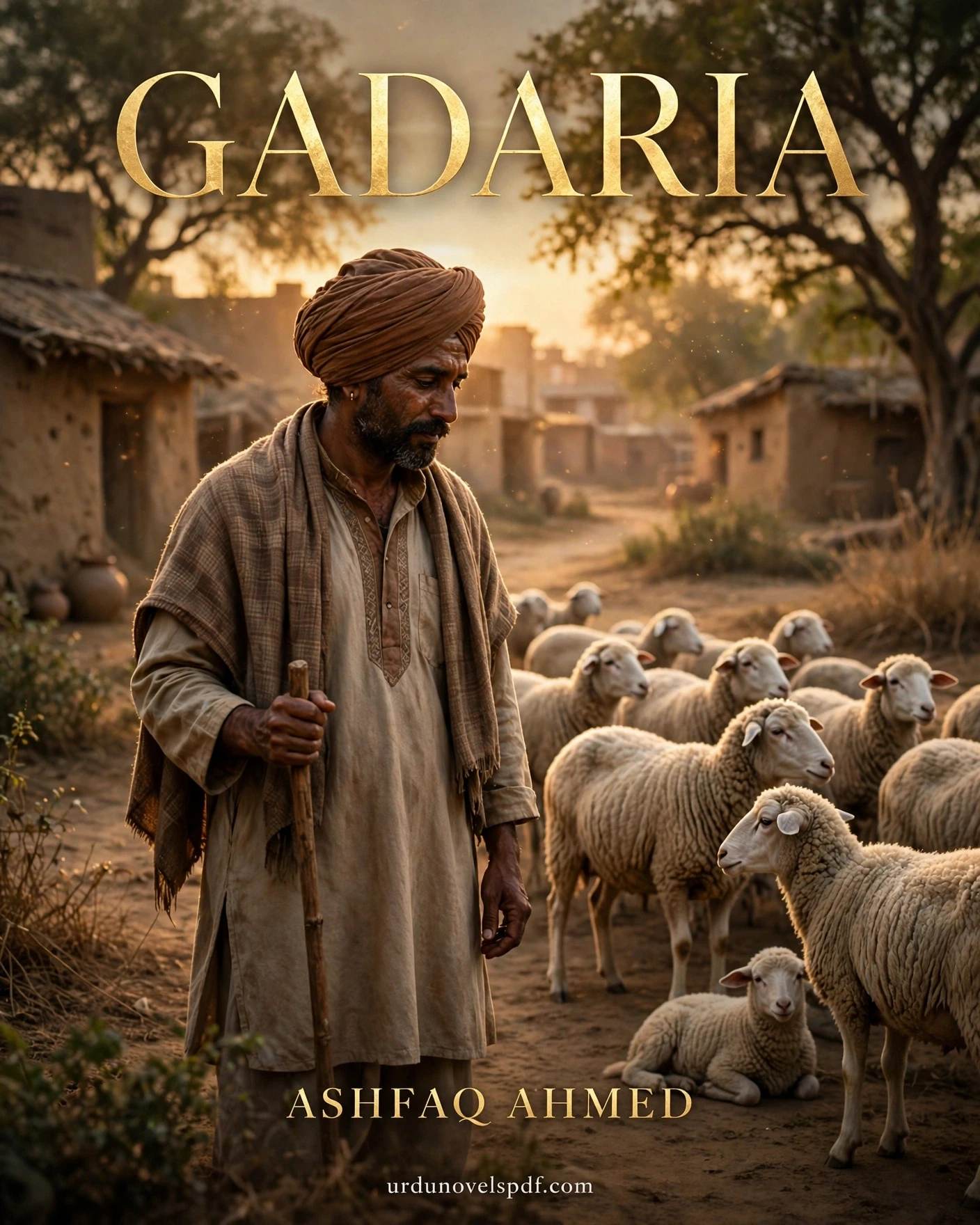
Gadaria by Ashfaq Ahmed is one of the most famous short stories in Urdu literature, and this page gives you the complete story, in its collection, to read online and download as a PDF, with an honest guide to what it actually is.
If you came here expecting a long romantic novel with a hero and a heroine, stop for a moment, because that expectation will mislead you.
Gadaria is not that kind of book at all, and understanding its real form is the first step to enjoying it.
Gadaria is a short story, an afsana, written in Urdu, and it is the title story of the collection published as Gadaria: Ujlay Phool.
This guide keeps every claim close to what the sources actually say, and it says plainly where the sources disagree, so you are never sold a confident story that the evidence does not support.
Quick Answer: Gadaria (Urdu: گڈریا, meaning The Shepherd) is a short story by Ashfaq Ahmed, not a novel.
It is the title story of the collection Gadaria: Ujlay Phool, long called his masterpiece.
Read the title story first, in one sitting, and then take the rest of the collection one story at a time.
Key Facts
- Form: a short story (afsana), the title story of a short-story collection, not a standalone novel.
- Author: Ashfaq Ahmed, Urdu writer, playwright and broadcaster from Pakistan.
- Language: Urdu, set in the world of 1950s and 1960s Punjab.
- Title meaning: Gadaria means shepherd, and the story is known in English as The Shepherd.
- Collection: Gadaria: Ujlay Phool, whose second-named story is Ujlay Phool, White Flowers.
- Early fame: biographical summaries commonly date the story’s early fame to 1955, while one book-list page says 1953, so neither year is asserted here as settled.
- Goodreads listing: 4.20 from 304 ratings and 25 reviews at crawl time, with a hardcover edition of 152 pages.
- Companion works: Zaviya, Aik Mohabbat Sau Afsanay, Safar Dar Safar, and the radio programme Talqeen Shah.
- Reading time: the title story in one sitting, the collection one story at a time.
| Story Name | Gadaria (Urdu: گڈریا, also spelled Gadariya, Gaddarya, Ghadriya) |
| Author / Writer Name | Ashfaq Ahmed |
| Genre | Short stories (afsane), literary fiction |
| Form | A short story, the title story of a collection, not a standalone novel |
| Collection | Gadaria: Ujlay Phool (Urdu: گڈریا: اجلے پھول) |
| Title Meaning | Gadaria means shepherd, rendered in English as The Shepherd |
| First Fame (as listed) | Commonly dated to 1955 in biographical summaries; one book-list page says 1953; neither year asserted as settled |
| Pages (as listed) | 152 pages in one hardcover listing; 160 pages in bookseller listings; counts differ by edition |
| Publisher (as listed) | Sang-e-Meel Publications, ISBN 969-35-1249-9 in bookseller listings |
| Status | Complete collection |
| Language | Urdu |
| Availability | Free PDF Download and Read Online |
Gadaria by Ashfaq Ahmed: What It Actually Is
The most important fact about Gadaria is also the fact most download pages get wrong, so it deserves to be said first and plainly.
Gadaria is a short story.
It is not a novel, it has no chapters following one hero and heroine through a long love story, and it should not be judged by the rules of a novel.
The published book carries the double title Gadaria: Ujlay Phool.
Gadaria is the title story, the piece the book is named for, and Ujlay Phool, White Flowers, is another story in the same collection.
So this page offers the collection that carries the story, not a single story on its own, and not a novel.
That distinction matters because the two most common errors about this book both come from ignoring it.
Some web pages call Gadaria a novel, and describe a shepherd whose life is transformed through various encounters, as if it were a long novel of spiritual awakening.
That description invents a novel that does not exist, and this page does not repeat it.
A reader who enjoys short, humane portraiture may also enjoy Manto Nama by Saadat Hasan Manto, another landmark Urdu short-story collection, though Manto’s satire is sharper and darker than Ashfaq Ahmed’s gentler tone.
Other pages treat Gadaria and Ujlay Phool as two separate books.
They are not.
They are two stories in one collection, named for both, with Gadaria first because readers remember it most.
The Title Story Gadaria: The Shepherd, at Theme Level
Gadaria, The Shepherd, is the story readers call Ashfaq Ahmed’s masterpiece, and the praise is remarkably consistent across years of reader reviews.
One reviewer calls it an unchallengeable art piece, another calls the book a masterpiece on the strength of this story, and several more describe it as one of his finest works.
This section stays at theme level, because the story itself should be read, not summarised away.
What the reviewers do agree on is the world of the story.
One Urdu-language reviewer describes Gadaria as a picture of rural life before Partition, and of what the Partition riots did to ordinary, non-political, decent people.
Another describes it as a pre-Partition story built around a teacher and a student.
Both point toward a small, ordinary world broken open by a great historical event.
The same reviewers agree on the feeling the story leaves behind.
One calls its ending heartbreaking, another says he felt the most pain for Ujlay Phool and Gadaria together, and a third notes that the endings of these stories are not always clear, and that some stories need an explanation after reading.
Gadaria does not tie everything up neatly, and a reader who expects a tidy, happy ending may be unsettled by it.
A similar collision between ordinary lives and great events runs through Khaak aur Khoon by Naseem Hijazi, though that historical novel works on a far larger canvas than a single short story.
One more claim about the title story deserves a plain answer.
Those pages say that Gadaria earned Ashfaq Ahmed early fame, and that after this story he was regarded by many as the best Urdu afsana writer after Saadat Hasan Manto, Ismat Chughtai and Krishan Chander.
That reputation is why the story is still assigned and argued about, long after the world it describes has vanished.
The Rest of the Collection: Ujlay Phool and the Other Stories
Beyond the title story, the collection gathers further short stories, and the reviewers’ comments on them are just as vivid as their comments on Gadaria.
The second-named story, Ujlay Phool, is the one readers mention most after Gadaria itself.
One reviewer writes that the Ujlay Phool story always makes her cry and leaves a very sad impression, another writes that he felt the most pain for Ujlay Phool and Gadaria, and a third lists Ujlay Phool among the stories in the book that made him cry.
The emotional report is consistent: it is a sad story, and it stays with the reader.
Reviewers also name other stories in the book, including Tinka, Barka and Pandit, and one reviewer singles out the ending of Pandit as the moment the whole collection fell into place for him.
He writes that he had expected the title story to be a linear novel, and that by the end of Pandit he was awed by Ashfaq Ahmed’s storytelling, in which a river is put into a pot, a small vessel holding something far larger than itself.
Readers who value that reflective, unshowy mode of writing may also find it in Dil Darya Samandar by Wasif Ali Wasif, a collection of reflections rather than a novel, though Wasif Ali Wasif’s voice is entirely his own.
How many stories the collection holds is one of the facts on which the sources disagree, and this page asserts neither figure as settled.
One reviewer describes five afsane, with Gadaria first, while another describes nine short stories.
Edition differences may explain the gap, but the sources do not say so.
What is certain is that Gadaria is first and most praised, and Ujlay Phool is named beside it.
Themes in Gadaria: What the Stories Keep Returning To
Unreciprocated love, with the shadow of Partition
One reviewer gives the whole collection a single sentence that many other reviewers echo in their own words: all the stories have a theme of unreciprocated love, with a tinge of the horrors of Partition.
Love here is not triumphant romance, it is love not returned or not completed, against a rupture nobody chose.
Ordinary people, not heroes
The second theme is ordinary people, and it is the reason the title story is remembered.
The shepherd, the villager, the teacher and the student are not grand figures, and their lives are not grand in the usual sense.
Their dignity comes from how they bear what happens to them, not from winning, and that is why readers describe the stories as sad and tragic at times, and also as deeply true to real life.
For readers coming from the classic Urdu novel tradition, the contrast is instructive, because a family saga such as Aangan by Khadija Mastoor builds its effect over hundreds of pages and many characters, while a Gadaria story builds its effect in a few pages around a single remembered world.
A vanished world, remembered in small things
The third theme is a vanished world, remembered through small, dated details.
One reviewer loves the book most for this, writing that the stories were written in the 1950s and 1960s and that it feels good to read about things that no longer exist in our lives, such as the telegram.
Another notes that tragedy strikes in these stories but life goes on.
That combination, of a lost everyday world and a life that continues after tragedy, is what makes the collection feel both historical and personal at once.
Endings that refuse to explain themselves
The fourth theme is the ending itself, and here the reviewers are divided in a way that is itself informative.
Some praise the sublime endings and the rich Urdu texture of the stories, while at least one reviewer complains that some endings were not clear enough and needed an explanation.
Ashfaq Ahmed does not hand the reader a moral at the end of a story.
He leaves the image standing, and trusts the reader to sit with it, which is why the stories repay a second reading.
Ashfaq Ahmed: The Writer Behind the Story
Ashfaq Ahmed, 22 August 1925 to 7 September 2004, was a writer, playwright and broadcaster from Pakistan, and one of the most loved voices in Urdu literature.
He wrote novels, short stories and plays for television and radio, and he received the President’s Pride of Performance and the Sitara-i-Imtiaz for his services to literature and broadcasting.
His birthplace is given differently in different sources, as Muktsar in Punjab and as Garhmukteshwar, so this page gives his birth date and his Punjab origins and asserts neither village as settled.
He began writing stories as a boy, and his early stories were published in Phool magazine.
Shortly before independence in 1947 he migrated to Pakistan and settled in Lahore, where he completed his Master’s degree in Urdu literature at Government College Lahore.
His classmate there was Bano Qudsia, herself one of Urdu’s great novelists, and she became his wife and his lifelong literary companion.
His working life was as varied as his writing.
After Partition he announced at the Walton refugee camp, worked for Radio Azad Kashmir, taught for two years at Dayal Singh College in Lahore, and went to Rome as an Urdu newscaster, taking diplomas in Italian, French and radio broadcasting.
Back in Pakistan he brought out the magazine Dastaango, joined Radio Pakistan, and edited Lail-o-Nahar.
In 1962 he began his long-running radio programme Talqeen Shah, and in 1966 he was appointed director of the Markazi Urdu Board, later renamed the Urdu Science Board.
In his later years he turned towards Sufism, in close association with Qudratullah Shahab and Mumtaz Mufti, and answered young people’s questions on television in Baithak and Zaviya.
Readers who know Qudratullah Shahab through Shahab Nama by Qudratullah Shahab will recognise the same literary generation here, and the same concern with ordinary goodness, expressed in the early shepherd story without any sermon.
He died on 7 September 2004 of pancreatic cancer, and was laid to rest in Model Town, Lahore.
He left behind more than twenty-five books, and his popular television plays include Aik Mohabbat Sau Afsanay and Tota Kahani, alongside the travelogue Safar Dar Safar.
Gadaria belongs to the early part of that output, and it is the work that first showed the literary world what he could do in a few pages.
Gadaria, Zaviya and Aik Mohabbat Sau Afsanay: Do Not Confuse Them
Because Ashfaq Ahmed’s books share an author and sometimes a shelf, searchers often confuse them, and a clear separation saves wasted reading.
Zaviya is his later work, the book and the television programme of spiritual talks and answers, in which he speaks directly to his audience about how to live.
It is not a story collection, and it should not be treated as an alternative title for Gadaria or as a continuation of it.
If you want Ashfaq Ahmed the teacher, read Zaviya, and if you want Ashfaq Ahmed the storyteller at his earliest best, begin with Gadaria.
Aik Mohabbat Sau Afsanay, One Love, A Hundred Stories, is a different collection again, and its television version became one of Pakistani television’s everlasting drama serials.
It shows the same storyteller at a larger scale, while Gadaria: Ujlay Phool shows him at a smaller, more concentrated scale.
Safar Dar Safar is a travelogue, and Talqeen Shah is a radio programme, not a book at all.
The confusion matters most for downloaders, because files are often mislabelled.
A genuine Gadaria file is a short-story collection whose first story is about a shepherd in the world before Partition, and whose second-named story is Ujlay Phool.
Any file that opens as spiritual discourses, or as a long novel, is a different book.
How to Read Gadaria: A Simple Reading Order
Start with the title story, Gadaria, and read it in one sitting, without hurrying past the atmosphere.
The rural world before Partition, the teacher and the student, and the shadow of the riots are not background decoration, they are the story, and they repay a second reading once you know how the story ends.
After that, read Ujlay Phool next, since readers name it beside Gadaria, and then take the remaining stories one at a time, rather than rushing through the collection as if it were a novel.
Read slowly, and keep a note of the small, dated details, the telegram and the village path, things that no longer exist in daily life.
The same one-story-at-a-time habit also suits Zarguzasht by Mushtaq Ahmad Yousufi, a collection of humorous essays and sketches, though Yusufi’s comedy is very different from Ashfaq Ahmed’s quiet, sad portraiture.
One reviewer warns, fairly, that the Urdu can be difficult in places.
Who Should Read Gadaria, and Who Should Choose Something Else First
Gadaria suits readers who love Urdu short stories, readers who want to understand Partition literature through ordinary lives rather than through politics, and readers looking for a short, serious book rather than a long commitment.
It suits students of Urdu literature who need a clear example of the afsana, and general readers meeting Ashfaq Ahmed before his later, spiritual work.
It suits less well readers who want a fast romantic novel or a thriller.
Such readers should begin elsewhere.
A reader in that mood might prefer a contemporary romantic story such as Teri Yaad Khaar-e-Gulaab Hai by Umera Ahmed, or a full-length family novel, and return to Gadaria when they want something quieter and sadder.
A reader who finishes Gadaria and wants more may turn next to Manto’s short stories, or to the spiritual talks of Zaviya.
How to Read Online and Download the Gadaria PDF
Use the buttons on this page to read Gadaria online or to download the complete PDF.
Read Online opens the collection in your browser, and Download PDF saves it to your device.
Both buttons use the same complete file, so choose whichever suits your reading habit.
A genuine Gadaria file is a short-story collection whose first story is the shepherd story, and whose collection title pairs Gadaria with Ujlay Phool.
Check the file you open against that description, so you do not mistake Zaviya, or a hundred-story collection, or a novel by another hand, for this book.
Gadaria by Ashfaq Ahmed: Frequently Asked Questions
Is Gadaria a novel?
No, Gadaria is not a novel.
It is a short story, an afsana, by Ashfaq Ahmed, and it is the title story of the short-story collection Gadaria: Ujlay Phool.
What does Gadaria mean?
Gadaria means shepherd.
The story is known in English as The Shepherd.
The Urdu title is گڈریا.
What is Gadaria about?
At theme level, Gadaria is about rural life before the Partition of India, and about what the riots caused by Partition did to ordinary, non-political, decent people.
One reviewer describes it as a pre-Partition story built around the relationship of a teacher and a student, and several reviewers describe its ending as heartbreaking.
This page does not retell the plot, because the story should be read, not summarised away.
Who wrote Gadaria?
Gadaria was written by Ashfaq Ahmed, an Urdu writer, playwright and broadcaster from Pakistan, born on 22 August 1925 and died on 7 September 2004.
He received the Pride of Performance and the Sitara-i-Imtiaz, wrote more than twenty-five books, and later became known to television audiences through Baithak and Zaviya.
What is Ujlay Phool?
Ujlay Phool, White Flowers, is another story in the same collection as Gadaria, and the published book is titled Gadaria: Ujlay Phool.
Reviewers mention Ujlay Phool more than any other story in the book after Gadaria itself, and they consistently describe it as a very sad story that moves readers to tears.
How many stories are in the Gadaria collection?
The sources disagree, so this page asserts neither figure as settled.
One reviewer describes five afsane, with Gadaria first, while another describes nine short stories.
Reviewers name Tinka, Barka and Pandit among the other stories, besides Gadaria and Ujlay Phool.
When was Gadaria written, and when did it bring Ashfaq Ahmed fame?
Biographical summaries commonly date the story’s early fame to 1955, saying that after it Ashfaq Ahmed was regarded as the best Urdu afsana writer after Manto, Ismat Chughtai and Krishan Chander.
One book-list page instead says he wrote the famous afsana Gadaria in 1953.
Because the sources disagree, this page asserts neither year as settled, and reports both.
How many pages is Gadaria: Ujlay Phool?
Page counts depend on the edition.
One hardcover listing runs to 152 pages, while bookseller listings give 160 pages, ISBN 969-35-1249-9.
Other editions may differ, so a single page count should not be treated as true of every printing.
Is Gadaria really Ashfaq Ahmed’s masterpiece?
Readers certainly treat it that way.
Goodreads reviewers call it his masterpiece, an unchallengeable art piece, and one of his finest works, and the book holds 4.20 from 304 ratings at crawl time.
How is Gadaria different from Zaviya?
Zaviya is Ashfaq Ahmed’s later work of spiritual talks and answers, given on television to questions from young people.
Gadaria is an early short story, a work of fiction set in the world before Partition.
They are different books in form, period and purpose.
How can I read or download the complete Gadaria PDF?
Use the Read Online and Download PDF buttons on this page.
Read Online opens the complete collection in your browser, and Download PDF saves it to your device for offline reading.
Check that the file you open pairs Gadaria with Ujlay Phool, so you do not mistake Zaviya for this book.
What should I read after Gadaria?
After Gadaria, read Ujlay Phool in the same collection, and then the remaining stories one at a time.
Readers who want more of Ashfaq Ahmed may turn to Zaviya for his later spiritual voice, or to Aik Mohabbat Sau Afsanay for his stories at a larger scale.
Readers who want more Urdu short stories may turn to Manto’s collections.
Is Gadaria suitable for students?
Yes, Gadaria is suitable for students of Urdu literature, especially as an example of the afsana and of Partition literature told through ordinary lives.
The title story is short enough for classroom discussion, and its themes of rural life, unreciprocated love and Partition give plenty to discuss without needing a long novel.
Students should still note the form honestly: a short story and a collection, not a novel.
Read it slowly, begin with Gadaria, continue with Ujlay Phool, and let each story leave its one clear image behind.
That is the reading the book asks for, and it is the reading it repays.