Dareechay by Shafiq ur Rahman – Complete PDF Download
urdunovelspdf.com
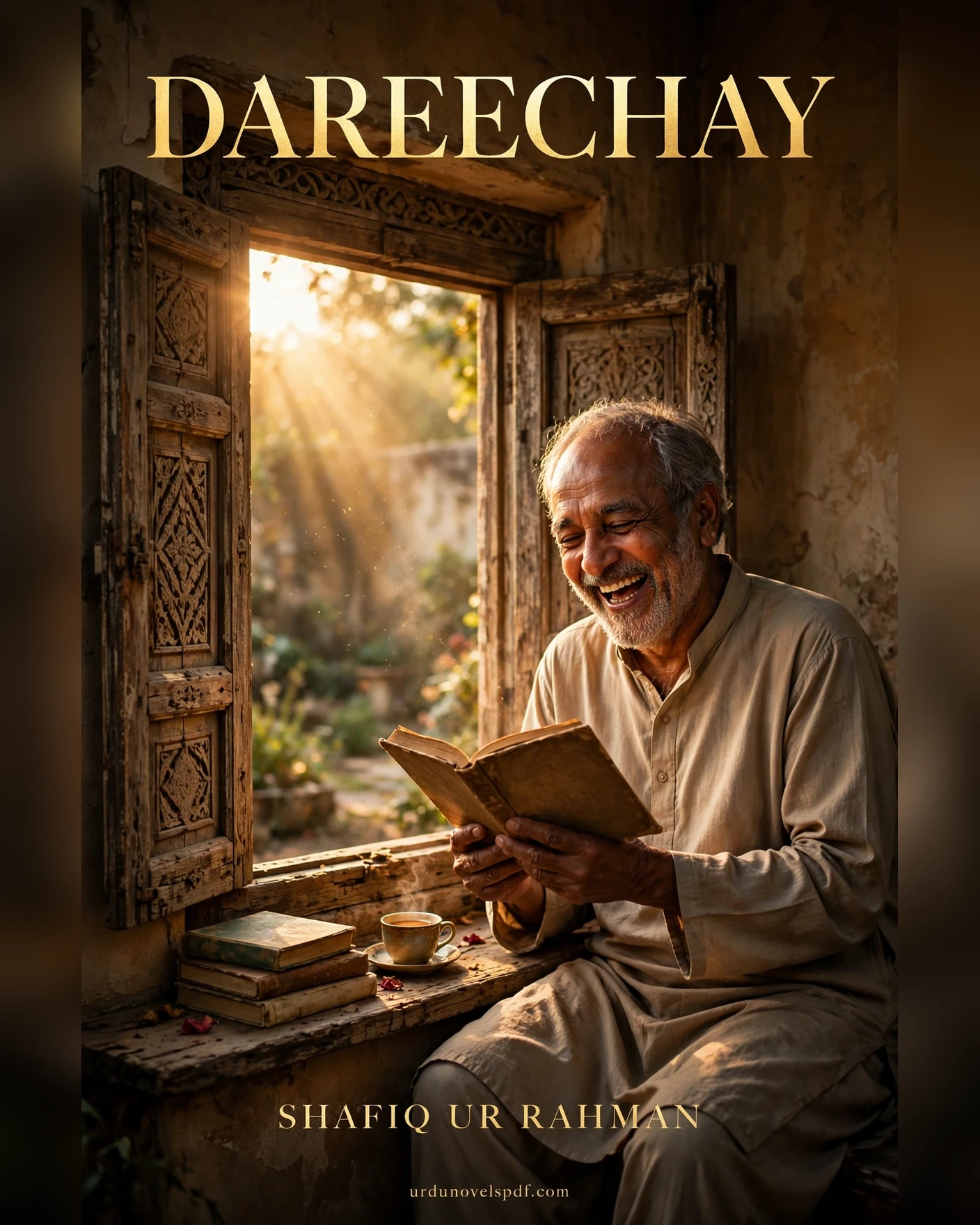
Dareechay by Shafiq ur Rahman is a late book by one of Urdu’s great humorists, and this page gives you the complete book to read online and download as a PDF, with an honest guide to what it actually is.
If you came here expecting a long romantic novel with a hero and a heroine, stop for a moment, because that expectation will mislead you.
Dareechay is not that kind of book at all, and understanding its real form is the first step to enjoying it.
Dareechay is a book of humorous short pieces in Urdu, published in 1989, near the end of a writing life that had already lasted half a century.
This guide keeps every claim close to what the sources actually say, and it says plainly where the sources are silent, so you are never sold a confident story that the evidence does not support.
Quick Answer: Dareechay (Urdu: دریچے, meaning Windows) is a 1989 book of humorous pieces by Shafiq ur Rahman, not a novel.
It belongs to the humour tradition of Hamaqatain and Mazeed Hamaqatain, and it should be read a piece at a time, not rushed through like a novel.
Download pages that file it as a social novel are using a generic label, not describing its form.
Key Facts
- Form: a book of humorous short pieces and essays (tanz-o-mazah), not a novel and not a romance.
- Author: Shafiq ur Rahman (9 November 1920 to 19 March 2000), Pakistani humorist, short-story writer, doctor and Army officer.
- Title meaning: Dareechay means windows, the plural of dareecha, a small window or opening.
- Book year: 1989, listed in the author’s bibliography by Wikipedia, Rekhta and the Rauf Parekh profile.
- Language: Urdu, in the author’s famously simple, spontaneous and expressive style.
- Place in his work: a late book, after Dajla (1980), following a long gap after his early run of humour books.
- Companion works: Hamaqatain, Mazeed Hamaqatain, Kirnein, Shagufay, Lehrein, Parwaaz, Pachtaway and Dajla.
- Not to be confused with: Dareechay by Wasif Ali Wasif, a different book by a different author with the same title.
- Reading habit: one piece at a time, ideally read aloud, since the humour lives in timing and repartee.
| Book Name | Dareechay (Urdu: دریچے, also spelled Dareeche, Darichay) |
| Author / Writer Name | Shafiq ur Rahman |
| Genre | Humour (tanz-o-mazah), humorous short pieces and essays |
| Form | A book of humorous pieces, not a novel, not a romance, no single plot or hero and heroine |
| Title Meaning | Dareechay means windows, windows onto ordinary life |
| Book Year (as listed) | 1989, in the author’s bibliography |
| Language | Urdu |
| Author’s Honour | Hilal-i-Imtiaz, awarded after his death in 2001 for military and civilian services |
| Status | Complete book |
| Availability | Free PDF Download and Read Online |
Dareechay by Shafiq ur Rahman: What It Actually Is
The most important fact about Dareechay is also the fact most download pages get wrong, so it deserves to be said first and plainly.
Dareechay is not a novel.
It has no single plot running from a first chapter to a last, no hero and heroine whose love story carries hundreds of pages, and it should not be judged by the rules of a novel.
The sources that can be checked place Dareechay firmly in Shafiq ur Rahman’s humour work.
Wikipedia’s bibliography lists Dareechay in 1989 among his books, after the travelogue Dajla of 1980, and Rekhta lists his writings under the humour heading of tanz-o-mazah.
Liberty Books sells Dareechay inside a collected set of his books alongside Pachtaway, Mazeed Hamaqatain, Dajla and Insani Tamasha, which is a humour shelf, not a romance shelf.
That distinction matters because the commonest error about this book comes from ignoring it.
Download sites that host every Urdu book file their pages under one generic label, and Dareechay is filed by at least one such site as a social novel.
That label is applied by the same site to all of Shafiq ur Rahman’s books, including his essay collections, so it is evidence of the site’s filing system, not of this book’s form.
This page does not repeat the error.
A reader who enjoys short, humane portraiture may also enjoy Manto Nama by Saadat Hasan Manto, another landmark Urdu short-story collection, though Manto’s satire is far sharper and darker than Shafiq ur Rahman’s gentle humour.
One more honest limit belongs in this section, because it shapes everything that follows.
No open source consulted for this page gives a contents list, a page count, or an ISBN for Dareechay itself.
Goodreads and the booksellers list his other books in detail, but for Dareechay they give the title, the author and the year, and little more.
This page therefore asserts no contents list, no page count and no single plot, and it discusses the book at theme level, through the author’s known humour method and his late position in life, rather than inventing pieces that no source names.
The Title Dareechay: Windows Onto Ordinary Life
Dareechay is the plural of dareecha, a small window, an opening in a wall through which you look out, or through which light and air come in.
The title is a promise about the book’s way of seeing, not a description of a building.
Each piece opens a small window, and through it you see a familiar scene for a few pages, and then the window closes, and another opens somewhere else.
That way of reading suits Shafiq ur Rahman’s humour exactly, because his humour has always worked in small frames.
His early books were collections of short, quasi-romantic and quasi-humorous stories, and his later books were collections of essays in which, as one critic quoted by Rauf Parekh puts it, the essay itself is only the thread that binds a collection of jokes together.
A window is the right image for that method, because a joke, like a view through a window, works only if it is framed tightly and left before it overstays its welcome.
Shafiq ur Rahman’s Humour: Wit, Repartee and Ordinary People
To understand Dareechay, you have to understand the humour of the man who wrote it, because his humour stayed recognisable across sixty years of writing.
Rauf Parekh’s profile, first published in Dawn, describes a humorist who ruled the world of Urdu humour for about sixty years, and who is still doing so, and it gives three qualities that explain why his books last.
The first quality is wit over slapstick.
Parekh quotes the judgement that Shafiq ur Rahman’s humour is not shy of practical jokes, but he uses them sparingly, and his playfulness stops just in time to save the humour from becoming tragedy.
He is also called the master of parody, which means his jokes work by imitating a serious style closely enough to show its absurdity, and then letting the imitation collapse at exactly the right moment.
The second quality is a world that is very real, with all its joys, pains and anguish.
His writing is described as an affirmation of life and of human values, of empathy, compassion and respect, and even seemingly frivolous situations are said to carry hidden meanings that probe deep into the human psyche.
That is why his humour never feels empty, even when the surface is light, because underneath the joke there is usually a small, serious observation about how people behave.
The third quality is language that is simple, spontaneous and expressive.
His sentences do not show off, and his jokes do not need footnotes, which is one reason his books travel so well to new readers, including readers whose Urdu is good but not literary.
A reader who knows the essay collections of Yusufi will recognise a cousin here, but the two voices are distinct, and a page of Yusufi should never be mistaken for a page of Shafiq ur Rahman.
Yusufi’s own masterwork of humorous essays, Zarguzasht by Mushtaq Ahmad Yousufi, is grander and more digressive, while Shafiq ur Rahman’s pieces are shorter, quicker and closer to the everyday scene outside the window.
The familiar cast of his world
Across his books, readers meet a recurring cast that became famous in its own right, and Dareechay belongs to that world even though no source consulted names its individual pieces.
The profiles name Shaitaan, also called Rufi, the mischief maker, Hukoomat Aapa, Maqsood Ghora, Buddy and Judge Sahab, alongside young women named Sarwat, Kishwer, Sa’da, Azra Aapa, Nasreen and Akhtar.
This page does not claim that any particular one of these figures appears in Dareechay itself, because no contents list for Dareechay is available to check, but a reader who knows these names will recognise the kind of company the book keeps.
A Late Book: Dareechay in 1989, After a Long Quiet
Dareechay is a late book, and its lateness is part of its interest.
Shafiq ur Rahman was born on 9 November 1920, so he was approaching seventy when Dareechay appeared in 1989, and he had been writing since his school days, when his humorous stories appeared in the literary monthly Khayyam.
His first book, Kirnein, was completed while he was still a medical student, and his great early run, Shagufay in 1943, Lehrein in 1944, Parwaz in 1945 and Hamaqatain in 1947, made him famous before Partition.
After that run, his book output shrank to a trickle for almost twenty-five years, while his life filled with medicine and the Army instead.
He completed his MBBS at King Edward Medical College, Lahore, in 1942, took postgraduate training in tropical medicine and public health at Edinburgh in 1952, served in the Indian Army Medical Corps during the Second World War, and after independence joined the Pakistan Army, where he eventually rose to the rank of general.
In December 1980 he became chairman of the Pakistan Academy of Letters, a post he held into the middle of the decade, with the end year given as 1985 in one source and 1986 in another, so this page says only the 1980s.
Dajla, his travelogue, appeared in 1980, and Dareechay followed in 1989, which makes Dareechay one of only two books in the last twenty years of his life.
A late book by a humorist is a particular kind of pleasure, because the jokes come from a man who has seen the same follies for fifty years and is no longer surprised by them.
This page does not invent a mellow or bitter tone for Dareechay, since no review of its individual pieces was found, but the position of the book in his life is itself a reason to read it slowly, as the work of a master looking back through his windows.
Late-life reflection takes a different shape in Dil Darya Samandar by Wasif Ali Wasif, a collection of reflections rather than a novel, though Wasif Ali Wasif’s voice is entirely his own, and the comparison shows how differently two late books can look.
Shafiq ur Rahman: Doctor, Soldier, Chairman, Humorist
Shafiq ur Rahman, 9 November 1920 to 19 March 2000, was a Pakistani humorist and short-story writer of Urdu, and a medical doctor by profession.
He was born in a Rajput family in Kalanaur, near Rohtak, in British India, and he received his education in Bahawalpur, before his medical training in Lahore and Edinburgh.
He died in Rawalpindi on 19 March 2000, and he was awarded the Hilal-i-Imtiaz for his military and civilian services after his death, on 23 March 2001.
He wrote until his death in March 2000, which means Dareechay, from 1989, belongs to his last decade of writing, not to his youth.
Readers who know Qudratullah Shahab through his memoir will recognise the same literary generation here, a generation that wrote in both English and Urdu institutions and that took public service seriously without losing its sense of humour.
On this site, that generation is best met through Shahab Nama by Qudratullah Shahab, though Shahab’s memoir and Shafiq ur Rahman’s humour are very different kinds of book, and the link is one of period and company, not of form.
Dareechay, Hamaqatain and Mazeed Hamaqatain: Do Not Confuse Them
Because Shafiq ur Rahman’s books share an author and a humour shelf, searchers often confuse them, and a clear separation saves wasted reading.
Hamaqatain, meaning Follies, appeared in 1947, and Mazeed Hamaqatain, meaning More Follies, is its sequel, with its first-edition year disputed between 1948 and 1954 in the sources.
Dareechay is a separate, much later book, from 1989, not a third volume of Hamaqatain and not a reissue of it under a new title.
The confusion matters most for downloaders, because files are often mislabelled, and collected sets mix the volumes together.
Liberty Books sells a collected set that contains Pachtaway, Mazeed Hamaqatain, Dajla, Dareechay and Insani Tamasha in one box, which is convenient for a collector but dangerous for a searcher, because a file labelled with one title may contain another.
A genuine Dareechay file is a late book of humorous pieces by Shafiq ur Rahman, dated 1989 in the bibliographies, and any file that opens as the early follies, or as a travelogue of the Tigris, is a different book, even if the author’s name matches.
The Other Dareechay: Wasif Ali Wasif’s Book of the Same Title
There is a second, entirely different book called Dareechay, and it is the single biggest trap for a searcher of this title.
Wasif Ali Wasif, the Sufi intellectual, poet and teacher, also wrote a book called Dareechay, listed among his works as a book of aphorisms, with a date of 2004 given in some listings.
It is a book of short, reflective sayings, not a humour collection, and it has nothing to do with Shafiq ur Rahman except the shared word for window.
Download pages mix these two books freely, because they file by title and not by author, and a searcher who downloads the first file called Dareechay may receive Wasif Ali Wasif’s aphorisms when they wanted Shafiq ur Rahman’s humour, or the reverse.
The check is simple, and this page urges every reader to apply it before reading.
Look at the author’s name on the title page, and look at the year, because Shafiq ur Rahman’s Dareechay is the 1989 humour book, and Wasif Ali Wasif’s Dareechay is the later book of aphorisms, and no file that lacks an author name should be trusted for either.
How to Read Dareechay: One Window at a Time
Start anywhere, because a book of short pieces has no first chapter that must be read first.
Open the book at any piece, read it through, laugh or smile at it, and then close the book and let the piece settle before opening another window.
Reading Dareechay straight through, as if it were a novel with a plot to follow, is the fastest way to dull its humour, because jokes need air around them, and a hundred jokes in a row become noise.
Read aloud where you can, because Shafiq ur Rahman’s humour lives in timing, in repartee, in the quick exchange of remarks between people who know each other well.
A joke read silently can look flat, while the same joke spoken, with a pause in the right place, lands exactly as it was written to land.
This is also why his books suit reading in company, with one person reading a piece and the others reacting, which is how his essays were often first enjoyed, as talk among friends.
The same one-piece-at-a-time habit also suits Maan Ji by Qudratullah Shahab, a short-story collection rather than a novel, though Qudratullah Shahab’s stories are sadder and more memoir-like than Shafiq ur Rahman’s humour, and the habit transfers even though the mood does not.
Who Should Read Dareechay, and Who Should Choose Something Else First
A reader in that mood should begin elsewhere, and return to Dareechay when they want something lighter and shorter.
A contemporary romantic story such as Teri Yaad Khaar-e-Gulaab Hai by Umera Ahmed will give that reader the love story they are looking for, and a full-length family novel will give them the long arc.
A reader who wants history on a grand scale, rather than humour in small frames, should turn to Khaak aur Khoon by Naseem Hijazi, though that historical novel works on a far larger canvas than a single humorous piece, and the contrast itself is instructive.
A family saga such as Aangan by Khadija Mastoor builds its effect over hundreds of pages and many characters, while a Dareechay piece builds its effect in a few pages around a single remembered scene.
Both are Urdu literature, and a reader who knows only one of the two modes knows only half the tradition.
How to Read Online and Download the Dareechay PDF
Use the buttons on this page to read Dareechay online or to download the complete PDF.
Read Online opens the book in your browser, and Download PDF saves it to your device.
Both buttons use the same complete file, so choose whichever suits your reading habit.
A genuine Dareechay file for this page is a book of humorous pieces by Shafiq ur Rahman, the 1989 book in his bibliography, not the early Hamaqatain volumes and not Wasif Ali Wasif’s book of aphorisms.
Check the file you open against that description, and check the author’s name on the title page, so you do not mistake a collected set, a travelogue, or another author’s windows for this book.
Dareechay by Shafiq ur Rahman: Frequently Asked Questions
Is Dareechay a novel?
No, Dareechay is not a novel.
It is a book of humorous short pieces and essays by Shafiq ur Rahman, published in 1989, and it has no single plot and no hero and heroine running through it.
What does Dareechay mean?
Dareechay means windows.
It is the plural of dareecha, a small window or opening, and the title suggests a book of brief views onto ordinary life, one window at a time.
Who wrote Dareechay?
Dareechay was written by Shafiq ur Rahman, a Pakistani humorist and short-story writer, born on 9 November 1920 and died on 19 March 2000.
He was a doctor by profession, an Army officer who rose to general, chairman of the Pakistan Academy of Letters in the 1980s, and recipient of the Hilal-i-Imtiaz.
When was Dareechay published?
Dareechay is listed as a 1989 book in the author’s bibliography, by Wikipedia, by Rekhta and by the Rauf Parekh profile.
It is a late book, after Dajla of 1980, and one of only two books in the last twenty years of his life.
What is inside Dareechay?
No open source consulted for this page gives a contents list for Dareechay itself, so this page asserts no list of pieces.
What is certain is its form, a book of humorous pieces in Shafiq ur Rahman’s established manner, and its position, a late book after a long quiet in his output.
How many pages is Dareechay, and what is its ISBN?
No page count or ISBN for Dareechay itself was found in the open sources consulted, so this page asserts neither.
Bookseller listings for his collected sets give prices and ISBNs for the set, not for this single book, and a set ISBN should not be quoted as this book’s ISBN.
How is Dareechay different from Hamaqatain and Mazeed Hamaqatain?
Hamaqatain, from 1947, and its sequel Mazeed Hamaqatain are his early humour books, while Dareechay, from 1989, is a separate and much later book.
They share an author and a humour shelf, but they are not volumes of one work, and a file of one should not be mistaken for another.
Is Dareechay the same book as Wasif Ali Wasif’s Dareechay?
No, they are different books by different authors with the same title.
Wasif Ali Wasif’s Dareechay is a book of aphorisms, listed with a 2004 date in some listings, while Shafiq ur Rahman’s Dareechay is the 1989 humour book.
Always check the author’s name on the title page.
How can I read or download the complete Dareechay PDF?
Use the Read Online and Download PDF buttons on this page.
Read Online opens the complete book in your browser, and Download PDF saves it to your device for offline reading.
Check that the file you open is Shafiq ur Rahman’s 1989 book, not a collected set or another author’s Dareechay.
Is Dareechay suitable for students?
Yes, Dareechay is suitable for students of Urdu literature, especially as an example of tanz-o-mazah and of a humour book from the last decade of a long career.
Its pieces are short enough for classroom discussion, and its title alone gives plenty to discuss about how a book frames its way of seeing.
Students should still note the form honestly, a book of humorous pieces, not a novel.
Read it one window at a time, begin anywhere, and let each small view stay with you before you open the next.
That is the reading the book asks for, and it is the reading it repays.