Mirat ul Uroos by Deputy Nazir Ahmad – Complete PDF Download
urdunovelspdf.com
Mirat ul Uroos by Deputy Nazir Ahmad is the book most readers meet first when they enter classical Urdu literature, and this page gives you the complete novel to read online and download as a PDF, with an honest guide to what it actually is.
If you came here expecting a modern romantic novel with a hero and a heroine, stop for a moment, because that expectation will mislead you.
This is a very different kind of book, and understanding its real form is the first step to enjoying it.
Mirat ul Uroos is a didactic domestic novel, written in Urdu and published in 1869.
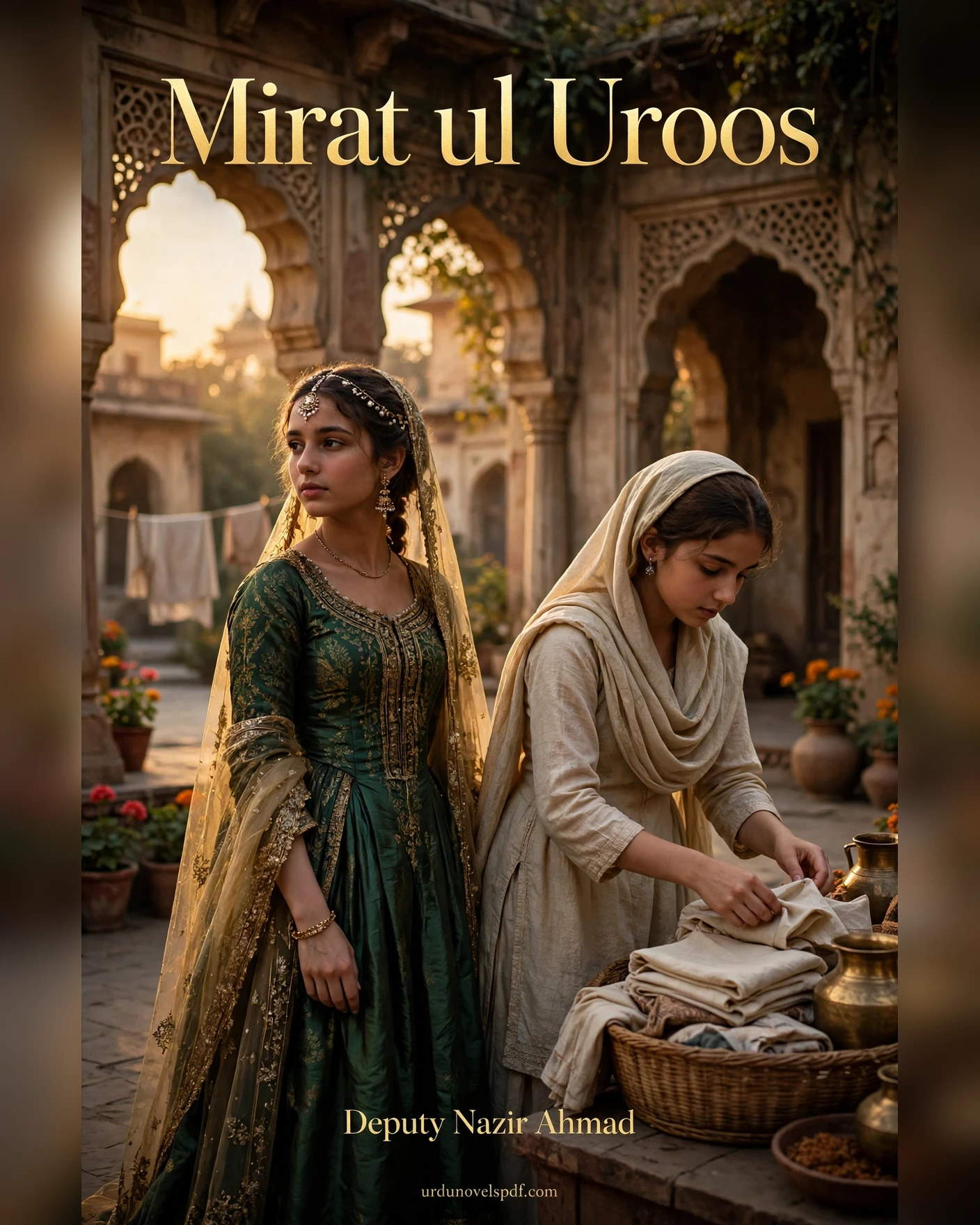
It tells the contrasting lives of two sisters, Akbari and Asghari, and it uses their stories to argue one clear point, that education matters more for a woman than for a man, because a woman runs the home and raises the next generation.
This guide keeps every claim close to what the sources actually say, and it says plainly where the sources disagree, so you are never sold a confident story that the evidence does not support.
Quick Answer: Mirat ul Uroos (Urdu: مراۃ العروس, The Bride’s Mirror) is a didactic Urdu novel by Deputy Nazir Ahmad, published in 1869.
It contrasts two sisters from Delhi, the elder Akbari, who is spoiled and poorly educated, and the younger Asghari, who is modest, hardworking and well educated.
Read it as a reformist novel of manners and household life, not as a romance, and read it slowly, because its lessons are carried by everyday domestic scenes, not by dramatic twists.
Key Facts
- Form: a didactic domestic novel, not a romance and not a collection of stories.
- Author: Deputy Nazir Ahmad, also written Nazir Ahmad Dehlvi, Urdu novelist, reformer and translator.
- Language: Urdu, set among a middle class Muslim family in Delhi.
- Published: 1869, the year given by the standard references; some summaries give the writing and publication span as 1868 to 1869, so the single year is the widely cited date, not a settled day or month.
- Title meaning: Mirat ul Uroos means The Bride’s Mirror, a mirror in which a young bride was meant to see how to conduct herself.
- Central characters: Akbari, the elder sister, and Asghari, the younger sister, married to two brothers.
- Their husbands: Muhammad Aqil, Akbari’s husband, and Muhammad Kamil, Asghari’s husband.
- Purpose: to promote female education and sensible household management in Muslim and Indian society.
- Early success: the book won a prize of one thousand rupees, and it is reported to have sold over one hundred thousand copies within a few years of publication.
- Sequel: Banat-un-Nash, published in 1873, continues Asghari’s story and shows her running a girls’ school.
- First novel claim: widely regarded as the first Urdu novel, but see the honest dispute explained below, because an earlier novel has also been claimed.
| Detail | Information |
|---|---|
| Novel Name | Mirat ul Uroos (also spelled Mirat-ul-Uroos, Miratul Uroos, Mirat ul Arus, Marat-ul-Uroos) |
| Author | Deputy Nazir Ahmad (Nazir Ahmad Dehlvi) |
| Form | Didactic domestic novel, not a romance |
| Language | Urdu |
| Setting | Delhi, a middle class Muslim household |
| Published | 1869 (widely cited; 1868 to 1869 span appears in some summaries) |
| Title meaning | The Bride’s Mirror |
| Main characters | Akbari (elder sister) and Asghari (younger sister) |
| Theme | Female education, household management, and respectable conduct |
| Sequel | Banat-un-Nash (1873) |
| English translation | The Bride’s Mirror, G. E. Ward, London, 1903 |
| File format | PDF, complete novel |
| Free PDF Download and Read Online | Use the buttons on this page |
Mirat ul Uroos by Deputy Nazir Ahmad: What It Actually Is
The most important fact about Mirat ul Uroos is also the fact most download pages get wrong, so it deserves to be said first and plainly.
This is a didactic novel, a book written to teach.
It is not a romance, it has no hero chasing a heroine through misunderstandings and reunions, and it should not be judged by the rules of a romance.
Its drama is domestic, and its stakes are a household run well or run badly, a marriage made peaceful or made miserable, and a young woman equipped for life or left unprepared for it.
The novel is built in two parts, and the shape of the book is the argument itself.
The first part follows Akbari, the elder sister, who is raised in privilege, spoiled, lazy and poorly educated.
When she moves to her husband’s house after marriage, she has a very difficult time, and her poor judgment and behaviour bring unhappiness on herself and on those around her.
The second part follows Asghari, the younger sister, who is modest, hardworking and educated well in a school.
She too faces a difficult transition after marriage, but through hard work, winsome manners and a good education she builds solid bonds with her husband’s family and with the people of her new society.
Nothing in this summary goes beyond the outline the standard references give, and no invented episode, dialogue or scene has been added to fill it out.
Akbari and Asghari: The Contrast That Carries the Novel
Akbari and Asghari are sisters, and they could hardly be more different, which is exactly the point.
Akbari is the elder, utterly spoiled, incapable of performing even the simplest domestic tasks correctly, and her story shows what happens when a girl is given affection without training.
Asghari is the younger, a gem in the ordinary household, who plunges into domestic chaos and straightens even the most impossible situations into perfect order.
Her own brother-in-law, Muhammad Aqil, praises her in the famous phrase quoted by scholars, calling her a girl out of a thousand.
Readers should not expect rounded, modern psychological characters here, and the critics are honest about this.
One scholarly reading describes the characters as close to fairy tale figures, where Asghari can do nothing wrong and Akbari can do nothing right, because each sister is a foil for the other.
That is a weakness if you want a modern novel, and it is a strength if you want a teaching story, because the lesson is never blurred.
The novel’s famous image, the mirror of the title, makes the same point: a young bride was meant to hold this book up to her own conduct, as if to a mirror, and ask how closely she resembled Asghari.
At the height of its popularity, scholars note, the book was often known simply as the tale of Akbari and Asghari, rather than by its title at all.
Why It Is Called the First Urdu Novel, and the Honest Dispute
Most reference works call Mirat ul Uroos the first novel of Urdu literature, and the first novel written by Deputy Nazir Ahmad.
That is the standard claim, and it is the claim most readers will meet first, so this page repeats it as the widely held view, not as an unquestioned fact.
There is a genuine dispute, and hiding it would mislead you.
A literary note published in 2023 argues that Khat-e-Taqdeer, written by Moulvi Kareemuddin in 1862, is Urdu’s first novel, with at least three editions appearing by 1865, and that Mirat ul Uroos, for all its fame, only eclipsed it in popularity.
Other summaries continue to give Mirat ul Uroos the first place, sometimes with the careful wording that it is the first original novel, or the first Urdu bestseller.
The safe, honest statement is this: Mirat ul Uroos is widely regarded as the first Urdu novel, it was certainly the first Urdu novel to become a bestseller, and a competing earlier claim exists and is noted here.
For exam readers, the expected answer remains 1869 and Deputy Nazir Ahmad, and for literary readers, the dispute itself is part of the book’s history.
Whatever the priority dispute, the book’s success is not in doubt.
It won a government prize of one thousand rupees, a very large sum at the time, and it sold over one hundred thousand copies within a few years of publication.
It was, in the words of one Punjab University study, the first Urdu bestseller, entering the world the year after cash prizes of up to one thousand rupees were offered to promote useful compositions in Hindi and Urdu.
That is why it sits on this list of the fifty best Urdu novels, and why it is still prescribed, quoted and argued about more than a century and a half later.
Deputy Nazir Ahmad: The Reformer Behind the Novel
Deputy Nazir Ahmad was an Urdu novelist, social and religious reformer, orator and translator, who wrote more than thirty books on subjects from law and logic to ethics and linguistics.
He is also remembered for translating the Quran into Urdu.
The title Deputy comes from his government service, and Dehlvi marks his connection with Delhi, the city where his most famous novel is set.
His birth year is given differently in different sources, 1830, 1833 and 1836 all appear, so this page asserts no single year, and his death in 1912 is the commonly given date.
What is not disputed is why he began writing fiction at all: he wanted suitable books for his own daughters, could not find books of the kind he wanted, and decided to write them himself.
Mirat ul Uroos grew out of that need, first as reading and training material for girls, and then as a novel that found a far larger audience than its author first intended.
Nazir Ahmad stood close to the reforming currents of his time, and in sympathy with the movement for social reform through educational uplift associated with Sir Syed Ahmad Khan, though the two men also differed on occasion.
His novels are reformist novels, written with a purpose, and Mirat ul Uroos is the clearest example.
His belief, quoted by scholars from the novel itself, was that education has more importance for women than for men.
The Themes: Education, the Household, and Respectable Conduct
The first theme is female education, and it is the theme the novel never lets go of.
Asghari’s schooling is not decoration, it is the source of her competence, her judgment, her manners and her ability to keep a household together.
Akbari’s lack of schooling is not a small flaw, it is the cause of her wastefulness, her quarrels and her misery.
The novel argues, scene after domestic scene, that a girl’s education is not a luxury for the rich, but the most practical preparation for married life.
The second theme is household management, and here the novel is at its most detailed and most enjoyable.
Its pages are crowded with the life of a Delhi household: markets and narrow lanes, festivals and weddings, moneylenders and cheats, servants, guests, expenses, meals and manners.
Scholars value the novel as a historical document for exactly this reason, because it preserves the everyday world of a middle class Muslim family in colonial Delhi in a way no official record does.
Akbari’s failures are practical too, and that is what makes the contrast sting.
The third theme is respectable conduct, or sharafat, and it is the theme modern critics examine most closely.
A scholarly reading of the novel stresses that Asghari is praised for keeping the family together, while Akbari’s wish for a separate, independent household is treated as a fundamental flaw.
Asghari is credited with talent and proficiency, good comportment, the right way of doing things, and kindness, and those qualities, taken together, are what make her the model daughter-in-law.
Akbari, by contrast, is criticised for her friendships outside her class, for her temper, and for her refusal to accept the discipline of the joint household.
Understanding this theme matters, because it explains both why the novel was loved as a guide, and why later readers argue about it.
The fourth theme is class, and it runs quietly through the whole book.
Akbari’s friendships with the daughters of a tinker, a water carrier and a greengrocer are presented as unsuitable, and her husband’s family objects to them.
Asghari keeps a careful distance from girls of the lower classes, and that distance is presented as part of her good sense.
Modern readers will rightly find this uncomfortable, and feminist critics have called the book’s ideals classist as well as didactic.
Readers who enjoy seeing how later Urdu writers handled similar social questions will find a useful contrast in Aangan by Khadija Mastoor, where a joint household is examined from a very different angle.
The Sequel and the Author’s Other Novels
Mirat ul Uroos did not end with Asghari’s marriage.
In 1873, Banat-un-Nash, also spelled Binat-un-Nash and translated as Daughters of the Bier, was published as its sequel.
It takes Asghari as its chief character again, and this time shows her running a girls’ school in her neighbourhood, teaching general education and physical sciences alongside religion and morality.
If Mirat ul Uroos argues for a girl’s education, the sequel shows what an educated woman can then do for other girls, and the two books are best read together.
Readers sometimes confuse the sequel with the original, or treat its school scenes as part of Mirat ul Uroos itself, so keep the two books distinct: the mirror first, the school second.
Deputy Nazir Ahmad wrote several more novels, and none of them is this book, so do not let a similar title mislead you.
Taubat-un-Nasuh, the repentance of Nasuh, is a moral tale about a father reforming his family, and it is the author’s next most famous novel.
Fasana-e-Mubtala, the tale of the afflicted one, published in 1885, follows a protagonist ruined by a taste for romantic Persian literature, a warning against exactly the kind of reading Nazir Ahmad distrusted.
Ibn-ul-Waqt, the son of the times, published in 1888, examines a man caught between old and new ways.
For a later example of a reformist historical novel written in a very different style, see Khaak aur Khoon by Naseem Hijazi.
Adaptations: The Dramas Are Not the Novel
Mirat ul Uroos has been adapted for television more than once, and the adaptations are popular, but they are not the novel, and their plots must not be confused with it.
Pakistan Television adapted the story under the same name, and in 2011 Hum TV aired a comedy version called Akbari Asghari, with a modern, humorous take on the two sisters.
In December 2012, Geo TV began a serial also called Mirat-ul-Uroos, written by Umera Ahmed and directed by Anjum Shahzad, which ran until June 2013.
That serial is explicitly inspired by the novel rather than a direct adaptation of it, and its story picks up where the original concludes, following the grandchildren of Akbari and Asghari.
Its characters, Aiza and Aima on one side and Hammad and Hashim on the other, belong to the serial, not to Deputy Nazir Ahmad’s book, and its marriages, quarrels and reunions are the serial’s invention.
How to Read Mirat ul Uroos Today
Start with the right expectation, and the book becomes a pleasure rather than a puzzle.
Expect a teaching story, told through household scenes, with clear heroes and clear warnings, and you will find it funny, sharp and surprisingly modern in its domestic detail.
Expect a modern romance or a fast moving adventure, and you will be disappointed, because the novel’s excitement is in watching a household tip toward order or toward chaos, one small decision at a time.
Then read the sequel, Banat-un-Nash, if you want to see where the author’s argument leads when Asghari becomes a teacher herself.
Language is the other practical question, and it has a good answer.
The Urdu of 1869 is classical and didactic, and modern readers sometimes find it formal, but it is also clear, direct and full of everyday speech, which is why it was written for young readers in the first place.
If Urdu is difficult for you, the English translation is a genuine alternative: G. E. Ward’s The Bride’s Mirror, published in London in 1903, with an afterword by Frances Pritchett in the modern reprint, gives the full story in English.
Students of classical Urdu poetry often pair this novel with Bang-e-Dara by Muhammad Iqbal, which shows a very different side of the same literary tradition.
Who Should Read It, and Who Should Skip It
This novel is for readers of classical Urdu literature, for students preparing Urdu exams, for anyone interested in the history of female education in South Asia, and for readers who enjoy domestic detail and social history.
It is also for readers who want to understand where the Urdu novel began, because whatever the priority dispute, this is the book that made the Urdu novel popular.
That limitation is itself worth reading about, because it shows how a reform can be both brave and bounded at the same time.
Readers who prefer a modern family saga with a strong contemporary heroine may enjoy Zarguzasht by Mushtaq Ahmad Yousufi or Manto Nama by Saadat Hasan Manto instead, but neither is a substitute for this book’s place in literary history.
Frequently Asked Questions
Is Mirat ul Uroos a love story?
No, it is not a love story in the modern sense. It is a didactic domestic novel about two sisters, their upbringing, their marriages and their households. There is no romantic hero chasing a heroine, and the emotional centre of the book is family life, not courtship.
Is Mirat ul Uroos really the first Urdu novel?
It is widely regarded as the first Urdu novel, and that is the standard answer in reference works and exam books. There is, however, a competing claim for Khat-e-Taqdeer by Moulvi Kareemuddin, dated 1862, argued in a 2023 literary note. The honest statement is that Mirat ul Uroos is widely regarded as the first Urdu novel and was certainly the first Urdu bestseller, with an earlier claim on record.
Who are Akbari and Asghari?
Akbari is the elder sister, spoiled, lazy and poorly educated, whose married life is full of difficulty. Asghari is the younger sister, modest, hardworking and well educated, who wins over her husband’s family through good manners and good management. The two sisters are married to two brothers, Muhammad Aqil and Muhammad Kamil.
What does Mirat ul Uroos mean?
It means The Bride’s Mirror. The title is a metaphor: the book was meant to be a mirror in which a young bride could see how to conduct herself, by comparing herself with Asghari, the model bride.
When was Mirat ul Uroos published?
In 1869, according to the standard references. Some summaries give the span 1868 to 1869 for its writing and publication, so the year 1869 is the widely cited date, while a single day or month is not asserted here.
Are Mirat-ul-Uroos, Miratul Uroos and Mirat ul Arus different books?
No, they are spelling variants of the same book. The Urdu title is مراۃ العروس, and its romanisation varies: Mirat-ul-Uroos, Mirat ul Uroos, Miratul Uroos, Mirat ul Arus and Marat-ul-Uroos all refer to Deputy Nazir Ahmad’s 1869 novel. This page uses Mirat ul Uroos, the form given in the post title.
Is the Geo TV drama Mirat-ul-Uroos the same story as the novel?
No, it is inspired by the novel, not a direct adaptation. Written by Umera Ahmed, it follows the grandchildren of Akbari and Asghari, with new characters such as Aiza, Aima, Hammad and Hashim. The PTV adaptation and the Hum TV comedy Akbari Asghari are likewise adaptations, not the novel itself.
What is the sequel to Mirat ul Uroos?
Banat-un-Nash, published in 1873, is the sequel. It follows Asghari again, this time running a girls’ school in her neighbourhood. Read Mirat ul Uroos first, then the sequel, to follow the author’s argument from a girl’s education to a woman teaching other girls.
Is there an English translation?
Yes, The Bride’s Mirror, translated by G. E. Ward and published in London in 1903, with a modern reprint carrying an afterword by Frances Pritchett. It is the standard English route into the novel for readers who do not read Urdu.
Is Mirat ul Uroos suitable for students?
Yes, it is one of the most prescribed texts in Urdu literature, and it is short, clear and rich in discussion material: female education, household life, joint family values, class, and the birth of the Urdu novel. Students should note the form honestly, a didactic novel of 1869, not a modern romance, and should read the novel itself rather than relying on a drama or a summary.
Mirat ul Uroos endures because it did something no Urdu book had done before at such scale: it put a girl’s education at the centre of a story, and it made ordinary household life feel important enough to write about.
Read it for Asghari’s quiet competence, for Akbari’s cautionary troubles, for its Delhi streets and households, and for its place at the beginning of the Urdu novel.
For the next step in classical Urdu reading, many readers turn to Kulliyat-e-Iqbal by Muhammad Iqbal or to Daastaan-e-Mujahid by Naseem Hijazi, and for a lighter modern contrast, Undlas Main Ajnabi by Mustansar Hussain Tarar and Maan Ji by Qudratullah Shahab show how far Urdu prose travelled after 1869.
Poetry readers may also enjoy Khushbu by Parveen Shakir, a very different kind of classic from a very different century.