Bazm Araiyan by Muhammad Khan – Complete PDF Download
urdunovelspdf.com
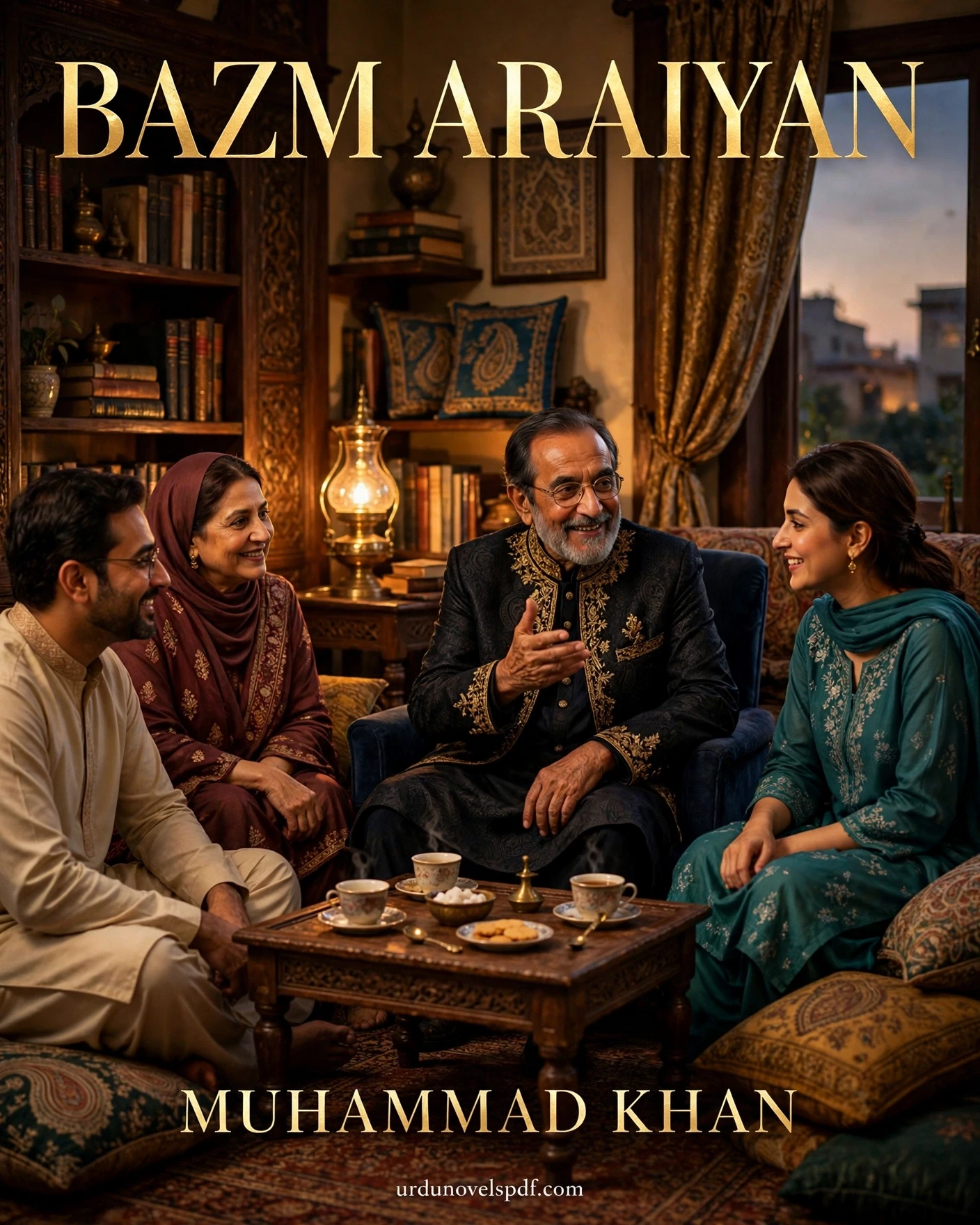
Bazm Araiyan by Muhammad Khan is one of the most loved humour books in Urdu, and this page gives you the complete book to read online and download as a PDF, together with the honest guide that other download pages never give you
It is not a long romantic novel, and it is not a war story
It is a collection of humorous, partly semi-autobiographical prose pieces by the same Colonel Muhammad Khan who made Urdu readers laugh with Bajang Amad, and it turns its humour on ordinary social life, on gatherings, on manners, and on the small vanities people do not notice in themselves
If you came here looking for a love story with a hero and a heroine, this page will save you a disappointment, because Bazm Araiyan offers something rarer: a room full of people, observed by a man who knew how to make a whole gathering laugh without ever raising his voice
Quick Answer: Bazm Araiyan by Muhammad Khan is a complete 1980 Urdu humour collection of semi-autobiographical short stories and prose pieces on social and romantic life, by Colonel Muhammad Khan, author of Bajang Amad.
On Urdu Novels PDF you can read it online and download the complete PDF using the buttons below.
| Book Details | Information |
|---|---|
| Book Name | Bazm Araiyan (Urdu: بزم آرائیاں) |
| Author/Writer Name | Muhammad Khan, widely known as Colonel Muhammad Khan |
| Genre | Urdu humour, semi-autobiographical stories and essays, satire |
| First Published | 1980 |
| Language | Urdu |
| Status | Complete book |
| Publisher (current listing) | Sang-e-Meel Publications |
| ISBN (current listing) | 9789693535686 |
| Availability | Read Online and Complete PDF Download |
Most pages that offer this book do little more than repeat its name and a download button, and some even confuse it with Bajang Amad, as if every book by Muhammad Khan were the same war memoir
That confusion is understandable, because the two books share an author and a humour, but the clearest way to avoid it is to start with the author’s own first book, Zarguzasht by Mushtaq Ahmad Yousufi, and then come to Bazm Araiyan as a different kind of book altogether
This page therefore begins with what the book actually is, then explains its title and its spellings, its themes, its humour, and its author, and only then asks you to use the buttons
The short answer is in the Quick Answer box below
The longer answer is in the sections that follow it, drawn from the book’s publisher listings, its Goodreads record, its author biography, and the one detailed description that actually describes its contents
Where those sources disagree or go silent, this page says so plainly, instead of inventing a plot, a character, or a story title that no source supports
Bazm Araiyan by Muhammad Khan: What Kind of Book Is It?
The first thing to get straight is the form, because it decides whether you will enjoy the book
A novel invents characters and follows them through a plot
Bazm Araiyan does not do that
Reference sources describe it, in the same words, as a collection of semi-autobiographical short stories, and the one detailed reader-facing description of its contents calls it a book of short stories and articles on social and romantic issues in the community
That is a different promise from a novel, and it is a better promise for the right reader, because each piece stands on its own, and you can read one piece at a time without losing the thread of a long story
Semi-autobiographical means the pieces draw on the author’s own life and observation, without claiming to be a straight autobiography
The author is present as an observer, a guest, and a listener who has seen enough gatherings to know how people behave when they think nobody is watching
The humour comes from recognition: you laugh because you have met that person, or sat through that gathering yourself
This honesty about form matters for another reason
Search results file almost every Urdu book under romance by default, and a reader who opens Bazm Araiyan expecting a romantic novel will be confused within a few pages
There are romantic themes in it, in the sense that social life includes love, marriage, and the relations between men and women, but there is no single love plot to follow, and no hero and heroine whose story carries the book
What carries the book is the author’s eye, and his judgement of the society around him, delivered as humour rather than as a lecture
The Title, Its Meaning, and Its Many Spellings
Bazm is an Urdu and Persian word for a gathering, an assembly, or a company of people met for talk, poetry, and pleasure
Araiyan belongs to the language of adornment and decoration, so the title suggests, in plain English, the adornments of a gathering: the talk, the wit, and the people who make a room worth sitting in
This page gives that reading as a plain-language guide to the words, not as a claim about a formal translation published by the author, because no source consulted gives an official English title for the book
The spelling problem is real, and it costs readers the book every day
You will find it as Bazm Araiyan, Bazm e Araiyan, Bazm Arraian, Bazam Arayan, and Bazam Araiyan, and the Urdu title is always the same: بزم آرائیاں
All of these spellings are the same book by the same author, so if you searched with a different spelling and landed here, you are in the right place
This page uses Bazm Araiyan throughout, because that is the spelling used by the current booksellers, and it keeps the other spellings visible here so that every searcher can recognise their own spelling
One spelling warning is worth giving separately: Bazm Araiyan is sometimes confused with Bajang Amad in sloppy catalogues
Bajang Amad (بجنگ آمد) is a different book, by the same author, about his army life in the Second World War, and its title means coming to war
What Is Inside Bazm Araiyan?
No verified table of contents for Bazm Araiyan was found in the sources consulted for this page, and this page does not invent one, nor does it claim any individual story title, character name, or plot event
What the sources do support is a clear picture of the book’s world: short, self-contained pieces about social life, gatherings, conversations, manners, courtship and marriage as social facts, and the small hypocrisies that polite society prefers not to name
The detailed download-page description puts it plainly: the book contains short stories and articles on social and romantic issues in the community
That phrase is the best short summary available, and it is honest in a way that longer invented summaries are not
Social issues here do not mean politics in the newspaper sense
They mean the everyday politics of a drawing room: who speaks, who listens, who shows off, who pretends, and who pays the price for pretending
Readers who enjoy that kind of social comedy will recognise the same tradition in Khaak aur Khoon by Naseem Hijazi, where a humorist’s eye does the work that a plot usually does
The second theme of the book is satire, and the sources are consistent about its character
Colonel Muhammad Khan satirises the evils of society in an intellectual form, so the joke is never just a joke: it carries a judgement, but the judgement arrives lightly, inside a funny observation, so the reader laughs first and only afterwards notices what has been criticised
The third thing to know is that some pieces from this book entered the educational syllabus, according to the same detailed description
That tells you the book is not throwaway reading, because teachers chose it for students, and its language is accessible enough for a classroom, which fits the same description’s note that the author used short and simple sentences
Bazm Araiyan and Bajang Amad: How the Two Books Differ
Because the two books are constantly mixed up, a direct comparison is the most useful section on this page
Bajang Amad (1966) is a humorous autobiographical memoir of the author’s service as a soldier in the Second World War, from his joining the British Indian Army in January 1940 through training, a posting near Bannu, and service in Iraq, Egypt, Palestine, and the Western Desert
Bazm Araiyan (1980) comes fourteen years later, after the author had become a famous humorist, and it turns from the army to society itself
The first book asks what war does to a young officer
The second asks what society does to ordinary people at a gathering
The humour is the same man’s, but the stage is different
In Bajang Amad the comedy comes from discipline, danger, and the absurdities of army life
In Bazm Araiyan it comes from manners, talk, and social pretence, with satire aimed at civilian evils rather than at military absurdity
A reader who loved the first book for its war stories should not expect more war stories here
The reading order question follows naturally, and the answer is simple
If you have read neither book, start with Bajang Amad, because it made the author famous and it teaches you his voice in its most dramatic setting
Then read Bazm Araiyan, and you will hear the same voice grown older, quieter, and more interested in the room than in the battlefield
If you have already read Bajang Amad, Bazm Araiyan is the natural next book, and the comparison table below makes the difference easy to keep in mind
| Book | What It Is |
|---|---|
| Bajang Amad (1966) | Humorous Second World War memoir. The author’s first and most famous book. |
| Basalamat Ravi (1975) | Travelogue of the author’s 1974 tour of England. A travel book, not a war memoir. |
| Bazm Araiyan (1980) | This book. Humorous semi-autobiographical stories and articles on social life. |
| Badesi Mazah (1992) | English humorous pieces adapted into Pakistani dress. Adaptations, not a memoir. |
Key Facts
- Form: a humour collection of semi-autobiographical short stories and prose pieces, not a novel.
- Author: Muhammad Khan, widely known as Colonel Muhammad Khan (1910 to 1999).
- First published: 1980, in Urdu. Goodreads lists 3 editions and a 3.99 average from 104 ratings.
- Subject: social and romantic life in the community, told with satire on the evils of society.
- Style: short, simple sentences, witty observation, and humour that never turns cruel.
- Do not confuse it with: Bajang Amad (1966), the author’s Second World War memoir.
- Publisher of the current listing: Sang-e-Meel Publications. ISBN of the current listing: 9789693535686.
The Humour of Colonel Muhammad Khan
To understand Bazm Araiyan, it helps to understand the humour that runs through all of Colonel Muhammad Khan’s work
The best description of it comes from Dawn’s profile of the author, which calls it a humour that could laugh at misery
The jokes are not pasted onto a story
They come from witty repartees, from an unusual perspective on misfortune, and from a man who could describe even dangerous or uncomfortable events as if they were a comic excursion
In Bazm Araiyan that same perspective is turned on social life, where the miseries are smaller but the pretences are larger
The style is part of the humour
The detailed description of this book stresses that the author used short and simple sentences
That simplicity is a choice, not a limitation
A short sentence leaves nowhere for a weak joke to hide, and it lets the observation land cleanly, which is why these pieces read easily even when their targets are serious
Readers who find some classic Urdu prose heavy will find this book a friendlier doorway, and students in particular will find its sentences quotable and its pieces short enough to study one at a time
The author was also a great admirer of Ghalib, and his use of Ghalib’s couplets in his work gives readers who know those couplets an extra layer of pleasure
No source consulted quotes a specific couplet from Bazm Araiyan itself, so this page claims none
Finally, the humour is never cruel for its own sake
Mushtaq Ahmad Yusufi, Zamir Jafri, Shafiq-ur-Rahman, Ibn-e-Insha, Muhammad Khalid Akhter, and Rasheed Ahmed Siddiqi all welcomed his first book with open arms, and that welcome is itself a judgement on the kind of humorist he was
About the Author: Colonel Muhammad Khan
Here is the name question, answered plainly, because it confuses many searchers
The author’s birth name was Muhammad Khan
He is mostly known as Colonel Muhammad Khan to distinguish him from other bearers of this very common name, and because he was a colonel in the Pakistan Army when his first book appeared
When he later dropped the title Colonel from his books and they began to appear under just Muhammad Khan, readers did not like it
They wrote letters saying the name somehow looked incomplete, and on their protest he restored the rank, while later editions again show just Muhammad Khan
Both names are the same man, and this page uses Muhammad Khan in its title while giving him his full Colonel Muhammad Khan credit here in the body
He was born on 5 August 1910 in Balkasar, a village in Chakwal district, Punjab
After schooling in Chakwal, where the writer Ghulam Jeelani Barq taught him Urdu and Persian, he took a Bachelor of Arts degree from Islamia College, Lahore, and a Master’s degree from Punjab University
He began as a poet under the pen name Sadiq, then wrote prose only, worked briefly as a sports writer for Eastern Times and then as a college lecturer, and joined the British Indian Army in the Second World War, later rising to colonel in the Pakistan Army
After his first book made him famous, he worked for many years as a staff member in the ISPR department, where, according to the detailed description of this book, other legends of Urdu literary history were also working
Faiz Ahmed Faiz, Syed Zameer Jafri, Shafiq Ur Rehman, and Siddique Salik had good relations with Colonel Muhammad Khan, and readers of Urdu cannot forget their services for the progress of Urdu humour
That circle matters for Bazm Araiyan, because a book about gatherings was written by a man who spent his working life among writers, and who knew a literary gathering from the inside
The same generation of humorists is the reason this book sits naturally beside Manto Nama by Saadat Hasan Manto on a classic Urdu shelf, even though the two books tell very different kinds of story
He died on 23 October 1999 in Rawalpindi and was buried in his hometown in Chakwal
His books stayed in print after him, and Bazm Araiyan is still listed by current booksellers, which is itself a verdict on a humour collection from 1980
Goodreads records a 3.99 average from 104 ratings across 3 editions, lower than Bajang Amad’s 4.27 from 266 ratings: the war memoir is the more famous book, and Bazm Araiyan is the quieter, later book, valued by readers who already know the author
Who Should Read Bazm Araiyan, and How
This book suits readers who like humour with substance
If you enjoy Urdu humour, social satire, short prose, or books about manners and gatherings, start here
Students of Urdu literature will find it especially useful: a classic example of modern Urdu humour, short enough to read in pieces and rich enough to quote
It also suits a reader who is new to classic Urdu prose and wants a gentle first classic
The pieces are short, the sentences are simple, and no long plot has to be held in memory from one sitting to the next, which makes it a good bedside book and a good gift for a reader curious about classic Urdu humour
It is not for readers who want a single continuous story, a romance with a hero and a heroine, or a book of war adventures
Those readers will be happier with a novel, or with Bajang Amad itself, and this page would rather send them to the right book than sell them the wrong one
Nor is it a book to read only for its jokes, because its satire has a point, and the point is that social evils survive by being treated as normal
The laughter is the delivery, not the whole message
Print Edition, Price, and How to Read or Download the PDF
If you prefer a printed copy, the current Sang-e-Meel Publications listing is in stock with several booksellers, and prices vary by seller: BooksNBooks lists it at PKR 1,280, while Liberty Books lists it at PKR 1,600, reduced to PKR 1,440 in its listing
Prices change, so treat those figures as a snapshot, and use the ISBN of the current listing, 9789693535686, to make sure you order this book and not another book by the same author
For most readers, however, the PDF remains the easiest way to reach the full text, and that is what this page offers
Use the buttons on this page to read Bazm Araiyan online or download the complete PDF
The buttons point to the full book file supplied for this page, so you can start reading at once on a phone or a computer, and keep the PDF for offline reading later
If a copy you find elsewhere turns out to be only a summary, or turns out to be Bajang Amad under the wrong title, check before you settle: the copy you want is the 1980 humour collection about social life, by Colonel Muhammad Khan, and its opening pieces should feel like gatherings, not like a battlefield
Frequently Asked Questions
Is Bazm Araiyan a novel?
It is a humour collection of semi-autobiographical short stories and prose pieces on social and romantic life, not a novel with a single plot, hero, and heroine.
Who wrote Bazm Araiyan, Muhammad Khan or Colonel Muhammad Khan?
His birth name was Muhammad Khan, and he is widely known as Colonel Muhammad Khan because he was a colonel in the Pakistan Army.
Later editions show just Muhammad Khan.
Are Bazm Araiyan, Bazm e Araiyan, Bazam Arayan, and Bazm Arraian the same book?
They are different Roman-Urdu spellings of the same Urdu title, بزم آرائیاں, by the same author.
If you searched with any of these spellings, this is the book you want.
Is Bazm Araiyan the same as Bajang Amad?
Bajang Amad (1966) is the author’s humorous Second World War memoir.
Bazm Araiyan (1980) is a later humour collection about social life.
Same author, different book.
What is Bazm Araiyan about?
No verified table of contents or individual story titles are claimed on this page, because no source consulted gives them.
When was Bazm Araiyan first published, and in which language?
Goodreads lists 3 editions and a 3.99 average from 104 ratings.
Is Bazm Araiyan funny or serious?
It is a humour book built on short, simple sentences and witty observation, but its satire carries a serious judgement about social evils.
Is Bazm Araiyan good for students?
Some pieces from the book were added to the educational syllabus, and its short pieces and simple sentences make it very suitable for students of Urdu literature.
What should I read after Bazm Araiyan?
Then try the other great Urdu humorists, especially Mushtaq Ahmad Yusufi’s Zarguzasht.
Final Verdict
Bazm Araiyan by Muhammad Khan earns its place on a classic Urdu shelf not by being the author’s most famous book, but by being his most social book
Bajang Amad showed what a soldier could make funny
Bazm Araiyan shows what a whole society looks like when the same eye turns to its gatherings, its talk, and its pretences, and finds them just as funny, and just as much in need of satire
It is short in its pieces, simple in its sentences, and serious underneath its laughter, and that combination is why teachers put it in a syllabus and booksellers still stock it
Read it after Dil Se Niklay Hain Jo Lafz by Farhat Ishtiaq, or read it first if social comedy is more your taste than war memoir, and read it piece by piece, in the evening, without hurrying
You will meet people you recognise, hear talk you have heard, and laugh at evils you may not have noticed before, which is exactly what good satire is supposed to do
For any reader of Urdu literature, and for any new reader looking for a gentle first classic, it is essential, enjoyable reading, more than forty years after it was published